


A profitable business can still miss its salary date. A 13-week forecast shows you the week before it happens.
Profit tells you whether the business is earning money. Cash tells you whether you can pay salaries, GST and suppliers on time. The two often move apart for weeks at a stretch, because customers pay late while your outflows arrive on fixed dates. A 13-week cash flow forecast closes that gap. This guide shows you how to build a 13-week cash flow forecast with ChatGPT and Excel for an Indian business, with ChatGPT doing the slow parts in a fraction of the time.
Updated November 2026 · By CA. M.S. Roy, Chartered Accountant
A 13-week cash flow forecast is a week-by-week plan of the cash you expect to receive and pay over the next quarter. It answers one practical question: in which week will the bank balance be lowest, and is that low point safe?
In this guide, you will learn what goes into the forecast, how to build it step by step, and where ChatGPT saves real time. ChatGPT can sort months of bank entries, suggest when each customer is likely to pay, test “what if” scenarios and write the weekly note for the owner. Every figure stays in Excel. A full worked example for a Noida distributor shows how one late customer turns a safe quarter into a cash shortfall.
- Forecast cash, not profit. Use actual expected receipt and payment dates, including GST and TDS.
- Thirteen weeks is one quarter: long enough to see a problem coming, short enough to forecast with reasonable accuracy.
- Use ChatGPT to classify, question and explain. Keep every calculation in Excel.
- Always run at least one stress scenario, such as your largest customer paying three weeks late.
- Update the forecast every week. A forecast that is not rolled forward stops being useful within a month.
What Goes Into a 13-Week Cash Flow Forecast
The forecast has only four building blocks. Learn these first, because every step later in this guide fills one of them.
| Block | What it contains | Where the data comes from |
|---|---|---|
| Opening balance | Bank balance at the start of week 1 | Bank statement, reconciled to the books |
| Receipts | Customer collections, other income, loan or capital inflows | Debtors ageing and each customer’s payment history |
| Payments | Suppliers, salaries, rent, EMIs, GST, TDS, PF, ESI, advance tax | Creditors ageing, payroll, loan schedules, compliance calendar |
| Closing balance | Opening balance plus receipts minus payments, for each week | Calculated in Excel |
The closing balance of one week becomes the opening balance of the next. That one rule is the whole engine of the forecast.
=D5+D12-D19In this layout, D5 is the week’s opening balance, D12 is total receipts and D19 is total payments. Copy the formula across thirteen columns, and set each week’s opening balance equal to the previous week’s closing balance.
Two Indian details catch many first-time forecasters. First, customer receipts include GST, so the GST you collect must also appear as a payment when GSTR-3B is due. Second, many customers deduct TDS before paying you, so the amount received is lower than the invoice. Forecast the amount that actually reaches your bank.
Where AI Helps in a Weekly Cash Flow Forecast, and Where It Must Not
Before you build a 13-week cash flow forecast with ChatGPT, understand what the tool is. ChatGPT is a language model. It is good at reading, sorting and explaining. It is not reliable for long chains of arithmetic. Divide the work on that basis before you start.
| Give AI this job | Keep this job in Excel |
|---|---|
| Classifying bank entries into receipt and payment heads | Weekly totals and closing balances |
| Suggesting collection timing from payment history | The final receipt amount in each week |
| Listing the outflows you might have missed | Exact due dates and amounts |
| Framing stress scenarios and the questions to ask | Scenario calculations |
| Writing the weekly note for the owner or the bank | Every number quoted in that note |
The 13-Week Cash Flow Forecast Excel Template already has this layout. It also flags weeks that fall below a safe cash level, and shows your cash runway, cash buffer coverage and a base vs stress comparison. You can enter your figures directly. The steps below explain what goes into each section and how AI helps you fill it.
How to Build a 13-Week Cash Flow Forecast with ChatGPT in Six Steps
Follow these steps in order. Your first 13-week cash flow forecast with ChatGPT and Excel takes about three to four hours. Each weekly update after that takes about thirty minutes.
Reconcile the opening bank balance
Start with the bank balance on the first day of week 1. Reconcile it to the books first, because an unreconciled balance carries its error into all thirteen weeks. List any cheques issued but not yet cleared, and deduct them. If you need help with this step, our guide to AI for bank reconciliation covers it in detail.
Also note any unused cash credit or overdraft limit. It is your safety net, but it is not cash. Keep it as a separate line below the closing balance.
Let AI classify three months of bank entries
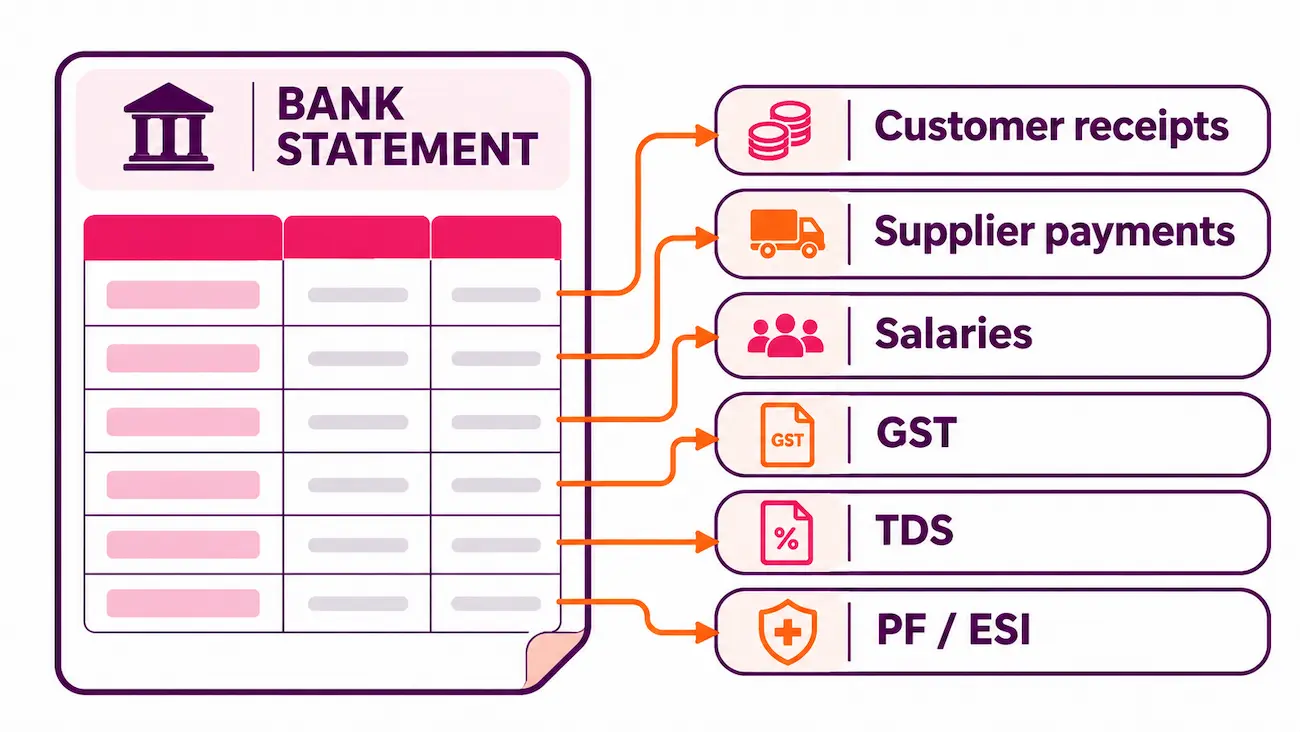
Past bank entries show your real pattern: which customers pay on time, which suppliers you pay weekly, and which costs repeat. Export the last three months from your bank, remove account numbers and personal names, and ask ChatGPT to sort the entries into heads.
Review every row marked “Check”. Then total each head by month in Excel. These monthly totals become your starting estimates for the forecast.
Place each customer’s payment in the right week
Receipts are the hardest part to forecast, because customers decide when to pay. Do not assume they pay on the due date. Use each customer’s actual payment habit instead. Give ChatGPT your debtors ageing and the average delay of each customer, and ask it to place each invoice in a likely week.
For sales not yet invoiced, estimate weekly sales from your order book and apply the same delay pattern. Be conservative here. An optimistic receipts line is the most common reason a forecast fails.
Put fixed dates first, then supplier payments
Payments are easier to forecast than receipts, because most of them fall on fixed dates. Enter them in this order: salaries, rent and EMIs; then statutory dues; then supplier payments. For most businesses filing monthly, TDS is deposited by the 7th, PF and ESI by the 15th, and GST through GSTR-3B by the 20th of the following month. Advance tax instalments fall due in June, September, December and March. Always confirm the dates that apply to your business.
Supplier payments follow your agreed credit terms. If a supplier is a registered micro or small enterprise, the MSMED Act requires payment within the agreed period, which cannot exceed 45 days. Delayed payments can be raised on the government’s MSME Samadhaan portal, so do not plan to fix a shortfall by holding back these suppliers.
Notice the last line of the prompt. AI can name a payment you forgot, but it can also state a wrong due date with confidence. Dates come from your compliance calendar, not from the chat.
CHECK
CA checkpoint: mask the data, and set a minimum balance
Before any bank or debtor data goes into a public AI tool, remove names, account numbers, PAN and GSTIN, as explained in our AI data security checklist. Also agree a minimum cash balance with the owner before you start, such as two weeks of fixed costs. The forecast is only useful if everyone knows which balance counts as a warning.
Run stress scenarios before the bank does
A single forecast gives you one possible future. A stress test shows what happens if one assumption goes wrong. Run at least two scenarios: your largest customer paying three weeks late, and sales falling by 15% for a month. Build each scenario in Excel by changing only the inputs. The template’s stress section lets you apply a collection delay or a revenue drop without touching the base case. Then ask ChatGPT what the results mean and what you can do about them.
If the plan relies on your cash credit limit, check your drawing power for those weeks. Drawing power falls when stock and debtors fall, so the full limit may not be available. Our guide to cash credit vs term loan explains how this works.
Compare actuals, explain the gaps, add a new week
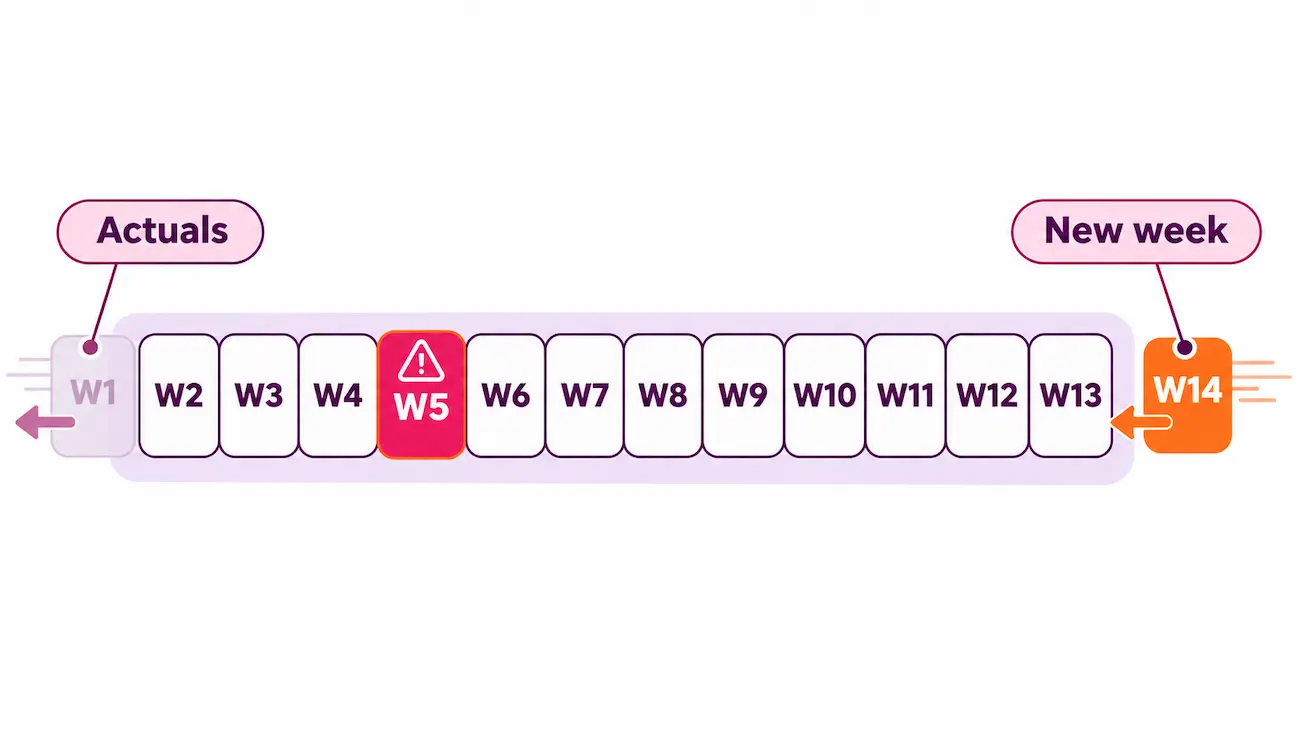
Every Monday, replace last week’s forecast with actual figures. Compare the two, explain any large difference, drop the finished week and add week 14. This weekly roll turns it into a rolling cash flow forecast. It becomes more reliable over time, because you learn where your estimates are usually wrong.
A Worked Example: A Noida Distributor’s 13-Week Cash Flow Forecast
Here is the method applied to a typical case. A Noida distributor of electrical goods prepares its forecast for the thirteen weeks from 30 November 2026 to 28 February 2027. Its opening bank balance is ₹12 lakh. It has ₹12 lakh of unused cash credit limit, and the owner wants at least ₹5 lakh in the bank at all times.
Its regular outflows are supplier payments of ₹11 lakh a week, salaries of ₹9 lakh on the 1st, rent of ₹2 lakh on the 5th, TDS of ₹1.2 lakh on the 7th, a loan EMI of ₹2.4 lakh on the 10th, PF and ESI of ₹1.5 lakh on the 15th, and GST of ₹6.5 lakh on the 20th. An advance tax instalment of ₹4 lakh falls due on 15 December. Its largest customer owes ₹12 lakh, expected in the week of 14 December.
₹ lakh · Weeks starting Monday| Week starting | Receipts | Payments | Net | Closing (base) | Closing (stress) |
|---|---|---|---|---|---|
| 30 Nov | 15.5 | 22.0 | −6.5 | 5.5 | 5.5 |
| 07 Dec | 16.0 | 14.6 | 1.4 | 6.9 | 6.9 |
| 14 Dec | 28.5 | 23.0 | 5.5 | 12.4 | 0.4 |
| 21 Dec | 15.0 | 11.0 | 4.0 | 16.4 | 4.4 |
| 28 Dec | 11.5 | 20.0 | −8.5 | 7.9 | −4.1 |
| 04 Jan | 15.5 | 16.6 | −1.1 | 6.8 | 6.8 |
| 11 Jan | 16.5 | 12.5 | 4.0 | 10.8 | 10.8 |
| 18 Jan | 17.0 | 17.5 | −0.5 | 10.3 | 10.3 |
| 25 Jan | 17.0 | 11.0 | 6.0 | 16.3 | 16.3 |
| 01 Feb | 16.5 | 23.2 | −6.7 | 9.6 | 9.6 |
| 08 Feb | 17.0 | 13.4 | 3.6 | 13.2 | 13.2 |
| 15 Feb | 17.5 | 19.0 | −1.5 | 11.7 | 11.7 |
| 22 Feb | 18.0 | 11.0 | 7.0 | 18.7 | 18.7 |
The base case looks safe. The balance never falls below the ₹5 lakh minimum, and the quarter ends at ₹18.7 lakh. The tightest week is the first one, when salaries and rent go out together.
Now look at the last column, the stress case. If the largest customer pays three weeks late, the ₹12 lakh moves from the week of 14 December to the week of 4 January. The balance drops to ₹0.4 lakh in the week of 14 December, the same week that GST, PF, ESI and advance tax are due. By the week of 28 December, when January salaries go out, the account is ₹4.1 lakh short.
To restore the ₹5 lakh minimum: ₹4.1 lakh + ₹5.0 lakh = ₹9.1 lakh from the CC limit
Unused CC limit after that drawing = ₹12.0 lakh − ₹9.1 lakh = ₹2.9 lakh
Base-case quarter: receipts ₹221.5 lakh − payments ₹214.8 lakh = ₹6.7 lakh net inflow (₹12.0 lakh opening to ₹18.7 lakh closing)
The business does not run out of money, but its safety margin almost disappears. Because the forecast flagged this in November, the owner has four weeks to act. Three practical actions follow:
- Call the large customer early and ask for a part payment before 18 December.
- Confirm with the bank that drawing power will support ₹9 lakh or more of extra CC use in late December.
- Move any non-critical purchase, such as new furniture or a large advance order, into January.
Without a weekly forecast, the owner would usually discover the problem in the week of 28 December, when salaries are due and the options are fewer and costlier.
13-Week Cash Flow Forecast Template
Weekly receipts and payments, funding gap alerts, cash runway, buffer coverage and a base vs stress scenario. Free download, no login.
Mistakes That Make a Cash Flow Forecast Wrong
Most forecasts fail for a small number of reasons. Check your first forecast against this list before you rely on it.
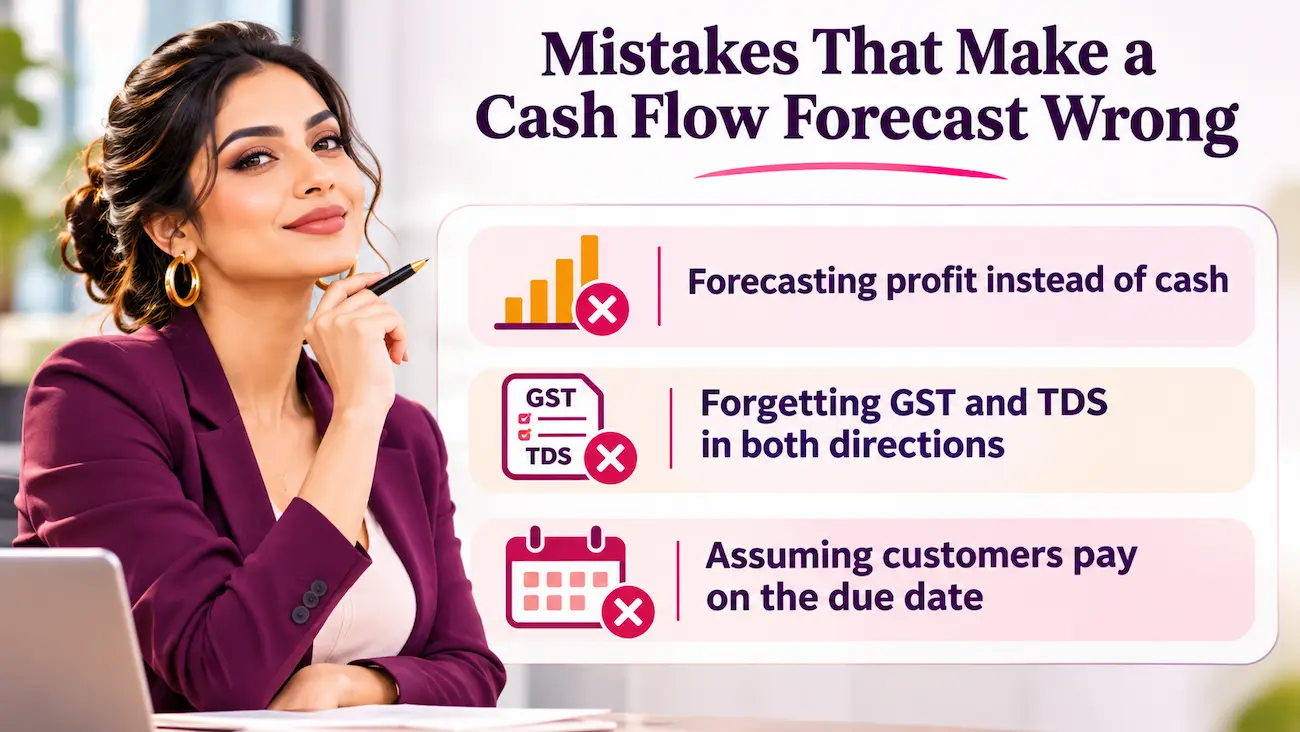
Forecasting profit instead of cash
Depreciation, provisions and credit sales affect profit but not this week’s bank balance. A cash forecast uses only money that actually moves in and out of the bank, on the date it moves.
Forgetting GST and TDS in both directions
Receipts include the GST you collect, and the same GST goes out with GSTR-3B. Customers may deduct TDS before paying, so you receive less than the invoice. Missing either side makes the forecast look better than reality.
Assuming customers pay on the due date
Use each customer’s actual payment history. If a customer has paid twenty days late for six months, forecast twenty days late.
Treating the CC limit as cash
An unused limit is only available up to your drawing power, and drawing power depends on your stock and debtors. Show it as a separate safety line, not inside the closing balance.
Building it once and never updating it
A forecast that is not rolled forward each week is out of date within a month. The weekly update is where the real value lies.
Taking AI arithmetic or dates at face value
AI can misplace a total or state a due date wrongly. Calculations stay in Excel, and dates come from your own compliance calendar.
See the low week early. Then you still have choices.
A 13-week cash flow forecast does not need advanced finance. It needs an accurate opening balance, honest receipt timing, a complete list of outflows and a weekly update. When you build a 13-week cash flow forecast with ChatGPT, let it handle the sorting, the checklists and the weekly note, and keep every number in Excel. The real benefit is time: a shortfall seen four weeks ahead can be managed calmly, while one discovered on salary day cannot.