
AI for Renewable Energy Accounting Isn’t the Same as Generic AI Accounting. SPV Accounting Requires Human Judgement.
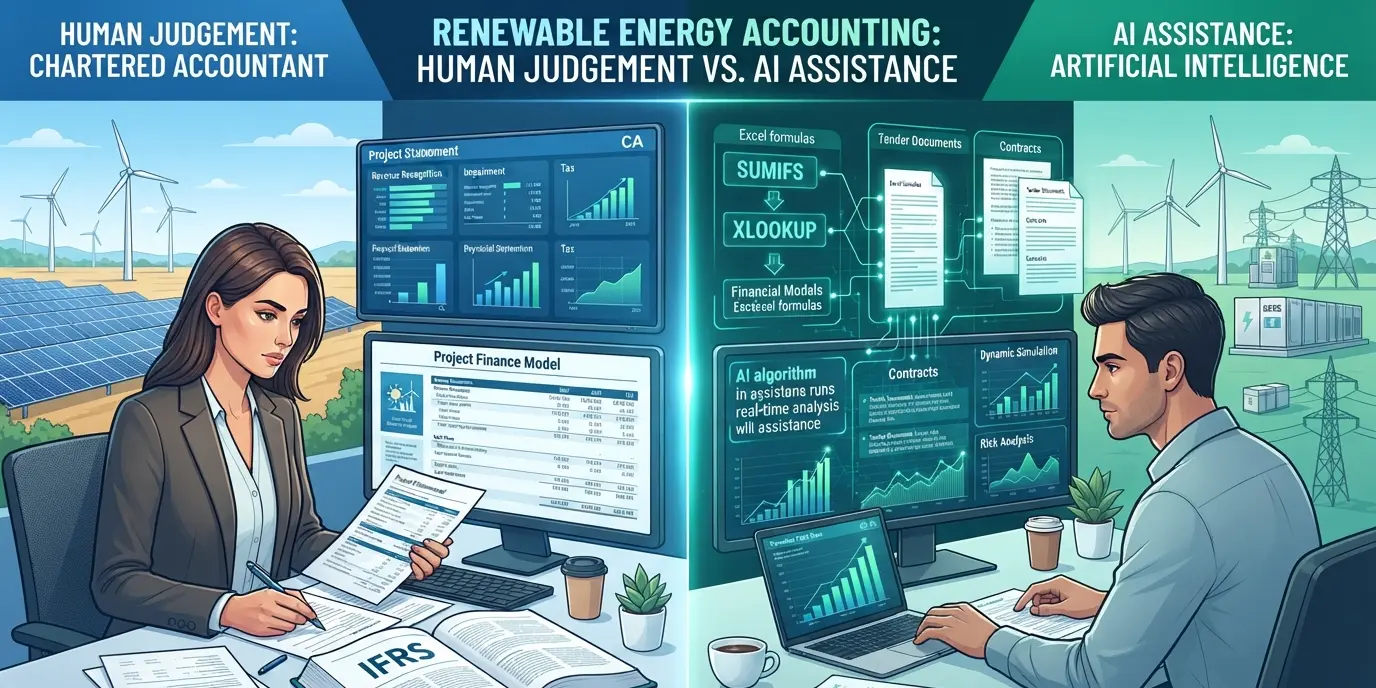
AI for renewable energy accounting can streamline financial model reviews, lender reporting, and document analysis, but it cannot replace the professional judgement required for SPV accounting, VGF grants, capitalised borrowing costs, GST classification, or PPA assessment.
Most content on AI for renewable energy accounting is written for a generic SME—a trading firm, a services business, or a company with a fairly ordinary balance sheet. A renewable energy or infrastructure SPV isn’t that. It’s a single-asset, project-financed entity built around one purpose: build, operate and repay debt against one power plant or one battery energy storage system (BESS). SPV accounting is genuinely more complex, involving borrowing cost capitalisation, Viability Gap Funding (VGF), GST input tax credit classification, lender reporting, and power purchase agreements that may even require lease assessment instead of standard revenue recognition. AI accounting advice that treats this like generic bookkeeping automation misses almost everything that actually makes renewable energy project accounting challenging.
This article is based on real renewable energy project accounting, SPV finance and BESS financial modelling experience. It explains where AI genuinely improves financial modelling, document review and lender reporting—and where professional judgement from a Chartered Accountant remains essential.
📑 Table of Contents
- AI genuinely speeds up model auditing, lender MIS drafting, and compliance checklist summarisation for SPVs.
- It cannot make the judgement calls that define SPV accounting: the GST civil-vs-plant split, VGF treatment under Ind AS 20, or whether a PPA is really a lease under Ind AS 116.
- Degradation and augmentation assumptions for renewable assets require engineering and commercial judgement AI doesn’t have access to.
- The more specialised the accounting, the more AI’s confident-sounding output needs independent verification — SPV work is exactly this kind of specialised.
Why SPV accounting is a different discipline
A renewable energy or infrastructure Special Purpose Vehicle exists for one reason: ring-fence a single project’s risk and financing from its promoters and from every other project in the group. That structural choice cascades into accounting complexity a normal SME never faces.
Borrowing costs during construction have to be capitalised under Ind AS 23 until the asset is substantially ready for use. Viability Gap Funding, where applicable, has to be accounted for as a government grant under Ind AS 20 — and how you treat it changes the shape of the balance sheet for the life of the project.
GST input tax credit is blocked on works contract services for civil construction under Section 17(5) of the CGST Act, but not on plant and machinery — which means every capex line has to be correctly classified before you know how much ITC you can actually claim. None of this is optional complexity. It’s the baseline for getting an SPV’s books right.
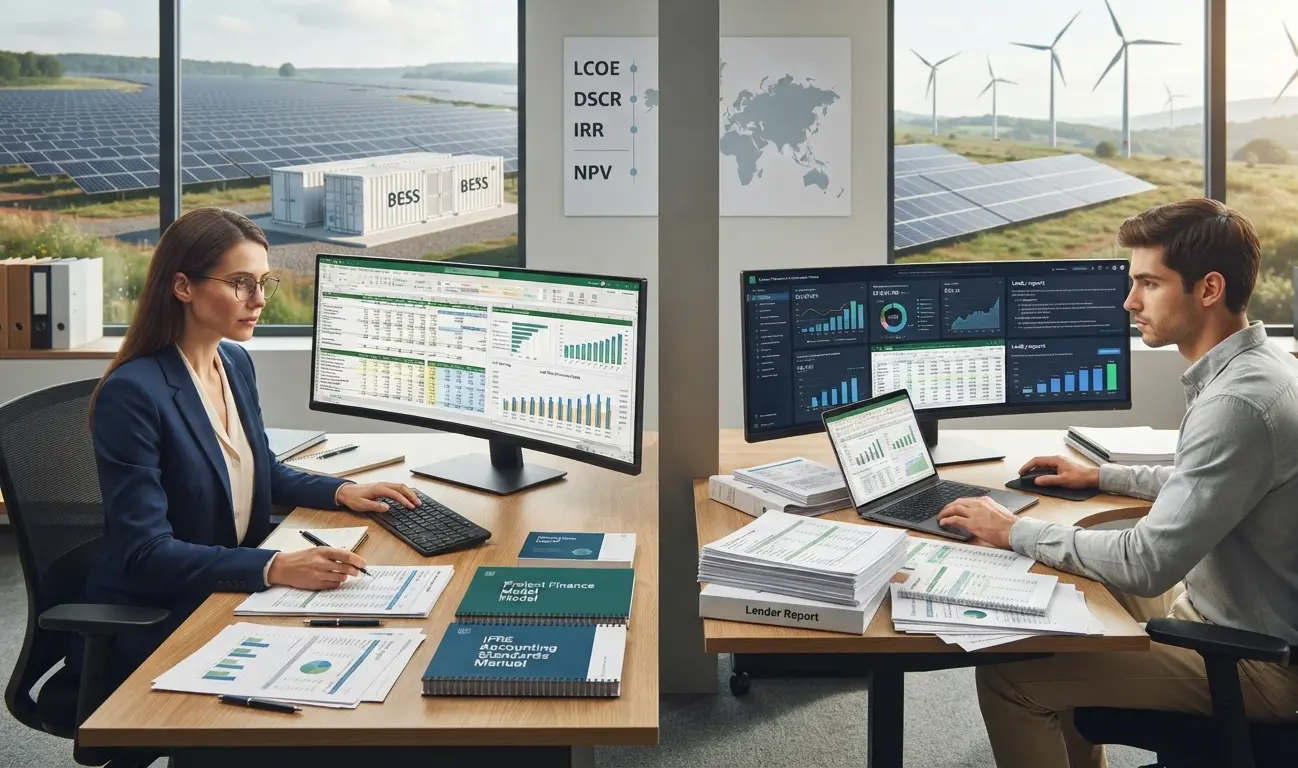
A working standalone BESS model, for reference, typically runs to around 15 linked sheets and 2,000-plus formulas, with balance sheet ties checked to zero across every project year and a dozen or more stress-test scenarios layered on top before a bid price is even proposed. That’s the scale of structure AI is genuinely useful for auditing — and the scale at which a single unverified AI-suggested formula can quietly break a lender’s confidence in the whole model.

Where AI SPV Accounting Genuinely Helps
Used on the right tasks, AI is a real time-saver in SPV work — four uses stand out from actual model-building and lender-reporting experience.
Auditing complex financial models. A 15-sheet SPV model with 2,000+ formulas is exactly the kind of structured, rule-based check AI is good at: tracing cross-sheet links, flagging where a formula pattern breaks from the rest of a row, catching a balance sheet that doesn’t tie to zero. This is mechanical verification, not judgement, and AI does it fast.
Drafting lender MIS packs. Once your DSCR, cash flow, and covenant figures are finalised, AI can draft the plain-English commentary lenders expect in a monthly or quarterly pack — the same way it drafts management commentary in a standard monthly close.
Summarising tender and PPA documents. SECI, state DISCOM, or other tender documents run to hundreds of pages. AI can extract the specific clauses — tariff structure, penalty terms, minimum generation obligations — into a working summary far faster than a manual first read, provided every extracted clause is checked against the actual document before it’s relied on.
Building sensitivity tables. Once the model logic is fixed, generating a DSCR or equity IRR sensitivity grid across tariff and capex scenarios is mechanical output generation — running a dozen-plus stress-test combinations by hand is exactly the kind of repetitive variation AI handles well, once you trust the underlying model it’s varying.
Pro tip
Never let AI touch the model’s actual formula logic unsupervised — use it to audit and explain existing formulas, not to write new ones into a live financial model. A single misplaced circular reference in a debt sculpting schedule can be very hard to catch later.

How I Use AI in Renewable Energy Project Finance
In my renewable energy project finance work, I use AI as a technical assistant rather than a decision-maker. It helps me review large Excel financial models for inconsistent formulas, summarise SECI and DISCOM tender documents, draft lender MIS commentary, analyse accounting standards, prepare SOPs, organise project documentation, and convert complex technical information into structured working notes. These tasks are repetitive and document-intensive, making them well suited for AI-assisted workflows.
However, every AI-generated output is independently reviewed before it becomes part of a financial model, lender submission, management report or statutory financial statement. I validate the results against the Excel model, project documents, financing assumptions, accounting standards and applicable regulations. AI significantly reduces the time spent on research, drafting and document review, but commercial decisions, debt structuring, accounting judgements, and final professional conclusions always remain the responsibility of the finance team and the reviewing Chartered Accountant.
Practical takeaway
AI delivers the greatest value when it accelerates repetitive technical work. It should support professional judgement—not replace it. In renewable energy project finance, the final responsibility for financial modelling, accounting decisions and lender reporting always rests with experienced finance professionals.

Where AI fails — the real judgement calls
These are the calls that actually define correct SPV accounting, and they require facts and judgement AI structurally doesn’t have.
GST capex classification. Whether a specific cost line counts as “civil work” (ITC blocked) or “plant and machinery” (ITC available) under Section 17(5) of the CGST Act often depends on the specific nature of the asset and how it’s fixed to the ground — a classification judgement, not a lookup.
VGF accounting treatment. Ind AS 20 permits either offsetting a government grant against the asset’s carrying value or recognising it as deferred income released over the asset’s useful life. Choosing between them, and applying it consistently, is a judgement with real balance sheet consequences — not something to let a tool default into.
PPA revenue classification. A power purchase agreement can, depending on its specific terms, meet the definition of a lease under Ind AS 116 rather than being accounted for as straightforward contract revenue under Ind AS 115 — a distinction that changes how and when revenue is recognised. Getting this wrong misstates revenue timing for the life of the project.
Degradation and augmentation assumptions. Battery and solar asset degradation curves, and the tender-benchmarked augmentation triggers that follow from them, depend on OEM data and engineering judgement specific to the equipment and site — not something a general-purpose AI model has any basis to estimate.
CHECK
REQ’D

The rule that keeps SPV work safe
Anywhere a standard uses language like “an entity shall assess” or “judgement is required” — GST classification, grant treatment, lease assessment, degradation assumptions — that decision belongs to the practitioner who understands this specific project’s facts. AI can draft around that decision. It should never make it.
The task-by-task breakdown
Mapped directly onto real SPV and renewable energy project accounting tasks:
| Task | AI role | Who owns the outcome |
|---|---|---|
| Auditing model formulas for consistency | Safe — mechanical verification | Reviewer confirms flagged issues |
| Drafting lender MIS commentary | Safe — first-draft structuring | Reviewer edits & signs off |
| Summarising tender/PPA clauses | Safe as a draft — verify against source | Practitioner confirms accuracy |
| GST civil vs plant & machinery classification | Risky — judgement, not AI’s call | Chartered Accountant only |
| VGF treatment under Ind AS 20 | Risky — accounting policy judgement | Chartered Accountant only |
| PPA lease classification under Ind AS 116 | Risky — contract judgement | Chartered Accountant only |
| Degradation & augmentation assumptions | Risky — engineering-dependent estimate | Technical team & reviewing CA |
Here’s the prompt structure I use for the one task on the safe side that saves the most time — auditing a model’s formula consistency before it goes anywhere near a lender:

The Model Can Be Audited by AI. The Project’s Judgement Calls Can’t.
SPV and renewable energy accounting rewards exactly the kind of specialised judgement that took years to build — GST capex classification, grant accounting choices, PPA lease assessment, degradation assumptions grounded in real engineering data. Done well, AI SPV accounting speeds up everything around those calls: the model audit, the lender pack, the tender summary. It was never going to make the calls themselves, and in this domain more than most, that’s exactly where the real value of a Chartered Accountant sits.
AI in SPV Accounting: Questions I Get Asked
Can AI build a financial model for a renewable energy SPV?
How does AI help with GST input tax credit on renewable energy projects?
Can AI decide how to account for Viability Gap Funding (VGF)?
Is a power purchase agreement (PPA) always accounted for as revenue?
Where does AI genuinely save time in SPV accounting work?