
Section 44ADA Is Becoming Section 58. Here Are the 5 ChatGPT Prompts Every Indian Freelancer Should Actually Be Using for Tax Planning.
The 50% presumptive rate, the ₹50 lakh and ₹75 lakh limits, the single advance tax deadline — none of it has changed. Only the section number has, from 1 April 2026 onward. Here’s the ChatGPT prompts for Section 44ADA workflow I actually use, and where the renumbering trips people up.
If you’re a freelance consultant, designer, developer, or anyone in a specified profession billing clients directly, 44ADA tax planning is probably the single most valuable thing you can get right each year. Declare 50% of your gross receipts as income, skip the books of accounts, skip the tax audit, pay one advance tax installment instead of four. It’s a genuinely good deal. Most freelancers still under-use it, because the eligibility rules and the calculations around it are easy to get wrong.
This guide gives you five ChatGPT prompts for Section 44ADA planning — eligibility, the 95% digital-receipts test, income declaration strategy, the advance tax deadline, and the paperwork — with the manual check that goes alongside each one. It also covers the one thing changing this year: from 1 April 2026, Section 44ADA is folded into a new consolidated Section 58 under the Income-tax Act, 2025. The rules underneath stay the same.
📑 Table of Contents
- 01What the 44ADA rules actually say
- 02Prompt 1 — Check you’re actually eligible
- 03Prompt 2 — Run the 95% digital-receipts test
- 04Prompt 3 — Decide what to actually declare
- 05Prompt 4 — Get the advance tax deadline right
- 06Prompt 5 — Draft the income computation note
- 07Three ways freelancers get this wrong
- 08A worked example for a freelancer
- 09Questions freelancers actually ask
- Section 44ADA lets specified professionals declare 50% of gross receipts as income — no books, no audit, one advance tax payment.
- The limit is ₹50 lakh, or ₹75 lakh if cash receipts stay under 5% of total gross receipts.
- From 1 April 2026, 44ADA is consolidated into Section 58 of the new Income-tax Act, 2025 — the rate, limits, and conditions carry forward unchanged.
- ChatGPT is genuinely useful for running these checks and drafting the numbers — it should never be your final word on whether your specific profession qualifies.
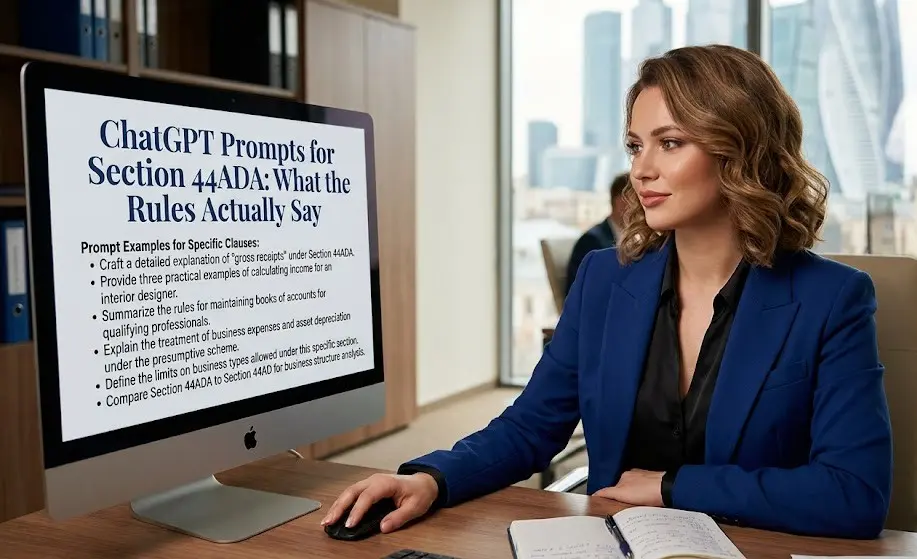
ChatGPT Prompts for Section 44ADA: What the Rules Actually Say
Section 44ADA applies to resident individuals, HUFs, and partnership firms — not LLPs, not companies, not non-residents — engaged in a profession specifically listed under Section 44AA(1). That list covers legal, medical, engineering, architecture, accountancy, technical consultancy, interior decoration, and a handful of later additions including film production and information technology. If your freelance work doesn’t fall inside that named list, 44ADA may simply not apply to you, whatever the general “freelancer” label suggests.
The gross receipts limit is ₹50 lakh in a year, rising to ₹75 lakh if your cash receipts stay under 5% of total gross receipts. The test is built around how much of your income comes through digital or banking channels rather than cash. Within that limit, you declare 50% of gross receipts as taxable income, or a higher percentage if you choose to. No books of accounts. No tax audit. And instead of the usual four advance tax installments, presumptive taxpayers pay everything in one shot, by 15 March.
What’s changing is the citation, not the substance. From 1 April 2026, Sections 44AD, 44ADA, and 44AE — covering businesses, professionals, and transporters respectively — are consolidated into a single Section 58 of the Income-tax Act, 2025, organised as one table with different rows for each category. The 50% rate, the ₹50 lakh and ₹75 lakh limits, and the single advance tax deadline are all reported to carry forward unchanged. Tax planning done for FY 2025-26 still cites Section 44ADA. From Tax Year 2026-27 onward, the same planning cites Section 58.
Pro tip
Unlike Section 44AD’s five-year lock-in if you opt out, 44ADA has no such restriction — you can move in and out of the presumptive scheme year to year based on whatever’s actually more favourable that year. Don’t let outdated advice about a lock-in talk you out of a year where 44ADA genuinely suits you better.
Prompt 1 — Check you’re actually eligible
“Freelancer” and “specified profession under Section 44AA(1)” are not the same thing. A freelance writer, a marketing consultant, or a coach may not be on the notified list at all, even though the word “freelance” makes 44ADA sound like it should apply.
What ChatGPT doesI describe the actual work and ask ChatGPT to check it against the specified list, flagging anything genuinely uncertain rather than guessing.
The promptCHECK
REQ’D
What I still check by hand
Borderline professions — general “consulting,” coaching, content creation that mixes writing and technical work — are exactly where a wrong assumption costs the most. If ChatGPT flags a case as borderline, that’s not a maybe you resolve yourself; that’s a genuine reason to get a professional opinion before filing.
Prompt 2 — Run the 95% digital-receipts test
The ₹75 lakh limit only applies if cash receipts stay under 5% of total gross receipts — and “cash” here means physical cash, not every non-bank-transfer payment. Miscounting this test wrongly assumes a higher limit than you actually qualify for.
ChatGPT’s jobI give it the year’s receipts broken into cash and digital, and ask it to run the actual percentage test.
What I askPrompt 3 — Decide what to actually declare
50% is the minimum you can declare, not a fixed rule — declaring higher is allowed and sometimes makes sense, for instance to show a stronger income history for a loan application. Treating 50% as the only option skips a genuine choice.
Handing it to ChatGPTI lay out the actual numbers and the reason I might consider declaring above 50%, and ask ChatGPT to lay out the tax cost of each option clearly.
Here’s the promptPrompt 4 — Get the advance tax deadline right
Presumptive taxpayers pay 100% of their advance tax in a single instalment by 15 March, not spread across the usual four dates. Missing that one date, or underpaying it, brings interest under Sections 234B and 234C, with no other instalments left to catch up on.
Where ChatGPT helpsOnce I have the declared income figure, I ask ChatGPT to calculate the estimated tax liability and confirm the single-instalment deadline clearly.
Copy thisPrompt 5 — Draft the income computation note
Even without a mandatory audit, a clear, simple computation note on file — for a loan application, a visa financial proof, or just your own records — saves real scrambling later. Most freelancers never bother writing one until they urgently need it.
Last prompt, ChatGPT’s turnWith every figure already confirmed through the earlier prompts, I ask ChatGPT to lay it out as a clean one-page note.
Final copy-paste
Three Ways Freelancers Get 44ADA Wrong
Three mistakes show up often enough to name directly. Mixing business and professional income in the same schedule. Trading or retail income belongs under the 8%/6% business rate, not the 50% professional rate — mixing them wrongly in one ITR schedule is a common trigger for a Section 143(1)(a) adjustment notice. Assuming every non-cash payment counts as “digital” for the 5% test. The test is specifically about physical cash versus everything else; get the categorisation wrong and you might wrongly believe you qualify for ₹75 lakh when you don’t. Missing 15 March because it doesn’t feel like a “real” deadline. With no quarterly instalments as reminders throughout the year, presumptive taxpayers are the ones most likely to let this single date slip past.
A Worked Example for a Freelancer Under Section 44ADA
A freelance software developer billed ₹68 lakh in gross receipts for the year, of which ₹2.5 lakh came in as physical cash from a couple of smaller local clients. Running Prompt 2’s test: cash receipts of ₹2.5 lakh against total receipts of ₹68 lakh works out to 3.7% — comfortably under the 5% threshold, so the ₹75 lakh limit applies, and ₹68 lakh sits well within it.
Declaring the standard 50%, taxable income comes to ₹34 lakh. The developer was applying for a home loan that quarter. Using Prompt 3, they weighed declaring a higher percentage to show a stronger income history, landing on 55% instead — a taxable income of ₹37.4 lakh, accepting a modest additional tax cost in exchange for a cleaner loan application. Prompt 4 then confirmed the full advance tax on that figure was due as one payment by 15 March, not spread across the year the way salaried tax deductions are.
The Scheme Rewards Getting the Numbers Right Once a Year. ChatGPT Speeds Up Getting There. It Doesn’t Replace Checking It.
ChatGPT prompts for Section 44ADA planning genuinely save time on eligibility checks, threshold calculations, and the paperwork — the mechanical half of what’s otherwise a once-a-year scramble. They don’t replace confirming your specific profession is on the specified list, or getting a professional’s sign-off before you file. With the section renumbering to 58 arriving alongside everything else changing this year, that verification habit matters more than ever, not less.