


Same ₹50 lakh from the same bank. ₹3.9 lakh a year, or ₹5.4 lakh.
Most owners compare loans by the interest rate on the sanction letter. The rate matters, but the type of facility often matters more. A cash credit limit, an overdraft and a term loan can carry the same rate and still produce very different bills, because each one charges interest, takes repayments and treats your stock in its own way. This guide shows the difference in rupees, using one manufacturing business as the worked example.
Updated November 2026 · By CA. M.S. Roy, Chartered Accountant
Cash credit vs term loan is one of the first real finance decisions a growing business faces, and it is usually made in a hurry. The banker offers a product, the owner signs, and the cost of the wrong choice shows up quietly over the next twelve months in interest, idle money and stressed cash flow.
In this guide, you will see how a cash credit (CC) limit, an overdraft (OD) and a term loan actually work, which one fits which need, and what each costs on the same ₹50 lakh. We will also cover the mistake that gets accounts marked irregular: using working capital money to buy a machine.
- Cash credit and overdraft charge interest only on the amount you use. A term loan charges interest on the full outstanding balance, whether the money is in use or sitting idle.
- Use cash credit for stock and debtors that rise and fall. Use a term loan for assets that last several years, such as machinery.
- An overdraft against your own fixed deposit is often the cheapest short-term money, because the deposit keeps earning interest, but only if you already have the deposit.
- Never fund a machine from your CC limit. The bank sees it as diversion, and your drawing power cannot carry it.
Cash Credit vs Overdraft vs Term Loan: The Three Facilities in Plain English
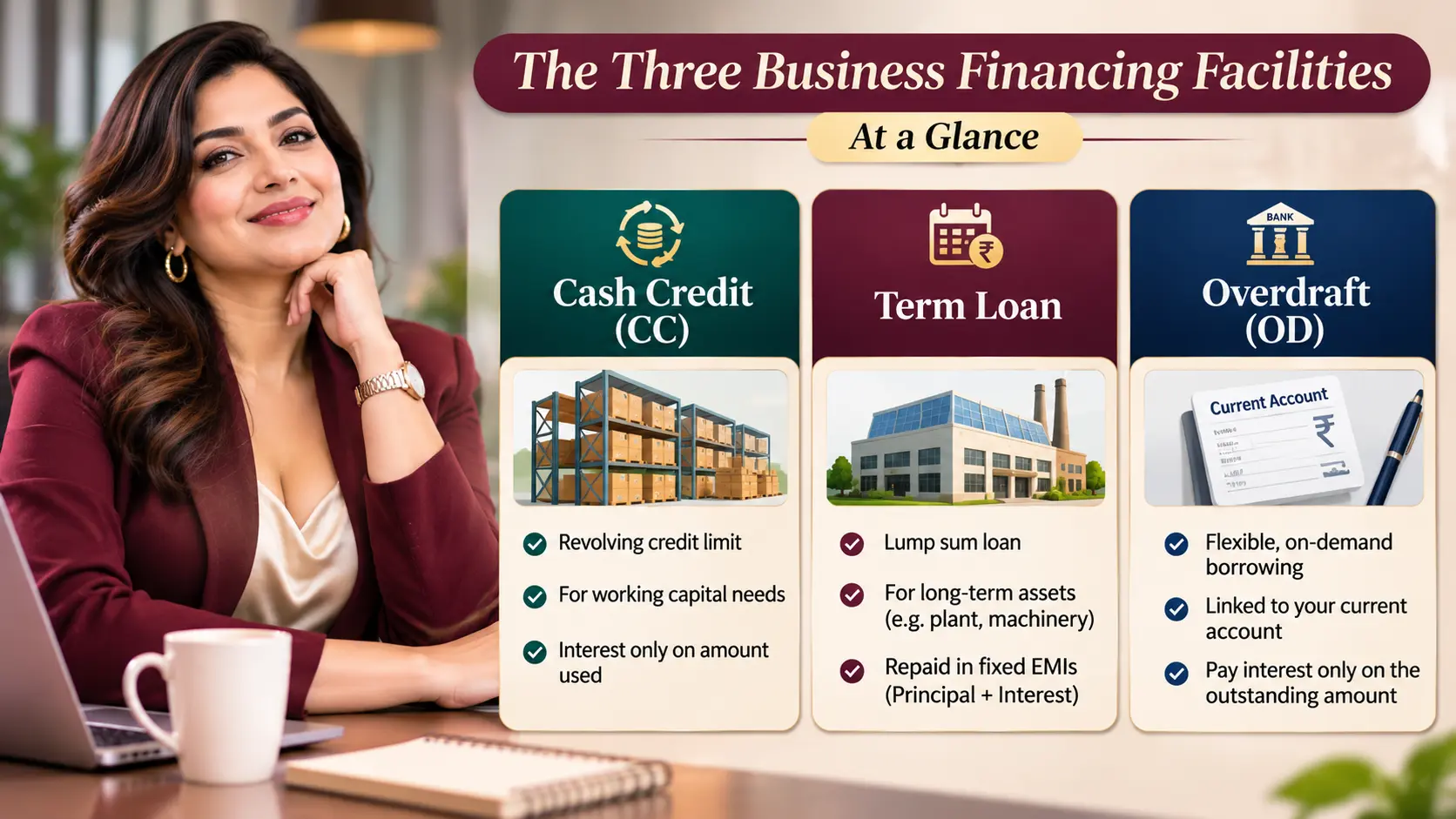
All three are bank finance, but they are built for different jobs, and most of the confusion in a cash credit vs term loan decision comes from treating them as the same product. The simplest way to remember the difference is this: cash credit follows your stock, an overdraft follows your security, and a term loan follows an asset.
| Feature | Cash credit (CC) | Overdraft (OD) | Term loan |
|---|---|---|---|
| Main purpose | Stock and debtors (working capital) | Short-term gaps and flexibility | Machinery, premises, expansion |
| Secured by | Hypothecation of stock and book debts | FD, property or other security, sometimes clean | The asset bought, plus collateral |
| How much you can draw | Lower of the limit and drawing power | Up to the sanctioned limit | Full amount, disbursed once or in stages |
| Interest charged on | Daily balance actually used | Daily balance actually used | Full outstanding loan |
| Repayment | No fixed schedule, renewed every year | No fixed schedule, reviewed periodically | Fixed EMIs over 3 to 7 years or more |
| Monthly paperwork | Stock and debtors statement | Usually minimal | Usually none after disbursement |
Since October 2019, banks must link new floating-rate loans to MSMEs to an external benchmark such as the RBI repo rate. So when the repo rate moves, the rate on your CC, OD or term loan usually moves with it at the next reset.
How Banks Decide Which Facility You Get
Before you compare costs, it helps to know how the bank thinks. A banker is not choosing the product that is cheapest for you. They are matching the facility to the purpose, the security and the cash cycle, because a mismatch is what turns a good borrower into a stressed account.
For working capital, the bank assesses how much money your stock and debtors lock up, usually through CMA data. For limits up to ₹5 crore to micro and small enterprises, many banks start with the turnover method, which we covered in our guide to AI for CMA data preparation. For a term loan, the bank looks at the asset, the project cash flows and the debt service coverage ratio (DSCR).
Security also shapes the offer. Under RBI’s master direction on MSME lending, banks must not take collateral for loans up to ₹10 lakh to micro and small enterprises. Above that, a guarantee under CGTMSE, which now covers loans up to ₹10 crore, can reduce the collateral the bank asks for.
Cash Credit vs Term Loan: How to Choose in Four Steps
These four steps take about an hour with your last year’s bank statements and a stock register. They work for a first application and for a renewal where you suspect the structure is wrong.
Separate money that comes back from money that stays put
List what the money will fund. Stock that you sell and debtors that pay you are working capital: the money cycles back every few weeks. A machine, a shed or a vehicle is a long-term asset: the money stays locked in for years. Most owners need both, so the answer is often a mix, not one product.
See what you can offer the bank
If you hold fixed deposits, an overdraft against them is usually quick and cheap. If your main assets are stock and receivables, the bank will offer cash credit against them. If you are buying an asset, the asset itself becomes the primary security for a term loan.
Whichever facility you choose, most banks will ask for the last two or three years of audited financial statements and income tax returns, recent GST returns, twelve months of bank statements and KYC documents. Cash credit usually adds a stock and debtors statement and CMA data. A term loan usually adds quotations for the asset and projected financials.
Price each option on what you will actually draw
Look at your bank statements and estimate your average borrowing across the year, not just the peak. Interest on cash credit or an overdraft is charged on that average. Interest on a term loan is charged on the whole outstanding balance. The Working Capital Calculator shows your real cycle and peak need in a few minutes.
Compare the fine print, not just the rate
Processing fees, renewal charges, commitment charges on the unused part of the limit, collateral, personal guarantees and prepayment terms can change the real cost. If you have offers from two banks, ChatGPT can lay them side by side for you. Remove your name, account numbers and addresses first.
The last line matters. AI is good at spotting a renewal charge buried on page three, but your interest arithmetic belongs in a spreadsheet you control.
CHECK
CA checkpoint: the renewal question nobody asks
A cash credit limit is usually sanctioned for twelve months and then reviewed. At renewal, the bank looks at your audited accounts, turnover and how the account was run through the year. Ask your banker at the start what they expect at renewal. Late stock statements and frequent overdrawing are the two things I see cause the most trouble.
A Worked Example: A Faridabad Manufacturer Costing ₹50 Lakh Three Ways
Here is a typical cash credit vs term loan case from a small manufacturer. A plastic-moulding business in Faridabad with sales of about ₹4 crore needs working capital that peaks at ₹50 lakh in its busy season. Across the year, it actually uses about ₹35 lakh on average. It also wants to buy a ₹40 lakh moulding machine.
To keep the comparison fair, we assume the same 10.5% interest rate for cash credit and the term loan. The overdraft is against fixed deposits at 8.5%. These rates and fees are illustrative, so use the figures from your own sanction letter.
Illustrative figures · One year| Option for ₹50 lakh working capital | How interest is charged | Interest | Fees | Year-1 cost |
|---|---|---|---|---|
| A. Cash credit, ₹50 lakh limit | 10.5% on ₹35 lakh average use | ₹3,67,500 | ₹25,000 | ₹3,92,500 |
| B. Five-year term loan, ₹50 lakh | 10.5% on the full reducing balance | ₹4,87,107 | ₹50,000 | ₹5,37,107 |
| C. Overdraft against FDs | 8.5% on ₹35 lakh average use | ₹2,97,500 | usually nil | ₹2,97,500 |
Term loan EMI on ₹50,00,000 at 10.5% for 60 months = ₹1,07,470 a month
Term loan year-1 interest = ₹4,87,107, plus a 1% processing fee of ₹50,000
Term loan year-1 principal repaid = ₹8,02,527, so total EMIs paid in year 1 = ₹12,89,634
Extra cost of the term loan over cash credit in year 1 = ₹5,37,107 − ₹3,92,500 = ₹1,44,607
The term loan costs about ₹1.45 lakh more in the first year, even at the same rate. There is a second problem the table does not show. The EMIs take out ₹12.9 lakh of cash in year 1, including ₹8 lakh of principal, from a business that still needs that money to buy stock. Meanwhile the unused part of the loan sits in a current account, which earns no interest. So the owner usually ends up asking for a cash credit limit anyway.
The overdraft is the cheapest line, and its real cost is even lower than the table shows. Your fixed deposit keeps earning interest while it secures the overdraft. If the deposit earns 7% and the OD charges 8.5%, your net cost is only the 1.5% gap on what you use: ₹35,00,000 × 1.5% = ₹52,500 a year. The catch is the deposit size. Most banks lend up to about 85–90% of the deposit, so a ₹50 lakh limit needs roughly ₹56 lakh or more in FDs. If you do not have that, the overdraft is not a real option.
Now the machine. A ₹40 lakh term loan over five years at 10.5% means an EMI of ₹85,976 and total interest of ₹11,58,536 over the five years. That is a fair cost for an asset that should earn for ten years or more. Pushing the same machine through the CC account would take usage to about ₹75 lakh against a ₹50 lakh limit, which the drawing power cannot support. The Capital Budgeting Template helps you check whether the machine pays for itself before you borrow.
Which Facility Fits Which Business Need
Use this table as a quick check before you meet the bank. It settles most cash credit vs term loan questions in a minute, because the right facility depends on how long the money stays in the business.
| Your situation | Usually the right fit | Why |
|---|---|---|
| Seasonal stock build-up | Cash credit | You pay interest only in the months you draw. |
| Customers pay in 60 to 90 days | Cash credit | Book debts back the drawing power. |
| Service business with no stock | Overdraft | No stock to hypothecate, and usage swings. |
| Short gap before a large receipt | Overdraft | Quick to draw and quick to repay. |
| Buying machinery or a vehicle | Term loan | Repayment matches the asset’s working life. |
| Setting up a new unit | Term loan plus cash credit | The asset and the working capital are funded separately. |
For a project loan, the bank will also test whether the cash flows can carry the EMIs. The DSCR and Debt Sculpting Template shows that calculation year by year.

Mistakes That Cost Owners Money
None of these mistakes needs complex finance to fix. Each one comes from treating the cash credit vs term loan choice as a formality, when it decides how much cash the business has every month.
Buying machinery from the CC limit
Can cash credit be used to buy machinery? Technically you can draw the money, but the bank treats it as diversion of working capital funds. Your drawing power is based on stock and debtors, not on a machine, so the account soon runs above its drawing power and is marked irregular.
Taking a term loan to run day-to-day expenses
As the example shows, you pay interest on money that sits idle and repay principal that the business still needs. This is the most common structure mistake I see in small businesses that grew quickly.
Comparing only the interest rate
Is cash credit cheaper than a term loan? Usually yes for working capital, because interest follows usage. But processing fees, renewal charges and charges on the unused limit can narrow the gap, so compare the full year’s cost.
Sizing the limit only on turnover
A limit set at 20% of turnover may be more or less than your real cycle needs. Check it against your stock and debtor days before you accept it, as we showed in the CMA worked example.
Late stock statements
Drawing power is calculated from the stock statement you submit. A late or careless statement can reduce your usable limit just when you need it, and it is noticed at renewal.
Working Capital Calculator
Find your real working capital gap and drawing power before you talk to the bank.
Match the loan to the job. The rate comes second.
In the cash credit vs term loan decision, the right answer is usually both, each doing its own job. Cash credit for stock and debtors, a term loan for assets that last, and an overdraft when you have deposits or a short gap to cover. Cost each option on your average use, read the full sanction terms, and keep machinery out of your working capital limit.