


Your client wants a ₹2.5 crore CC limit. The CMA data says ₹1.5 crore.
Most CMA files that bounce back from the bank were not short on effort; they were short on logic. The figures did not tie across forms, the projections had no reasons behind them, and nobody noticed that the limit asked for could not be supported by the balance sheet. This guide shows how to use ChatGPT to catch those gaps before the banker does, while Excel keeps every number honest.
Updated October 2026 · By CA. M.S. Roy, Chartered Accountant
CMA data preparation is still one of the most time-consuming jobs in an Indian CA practice. Every working capital renewal and every new cash credit proposal needs it. The work is repetitive, but one wrong mapping or one unexplained jump in sales can delay a sanction by weeks.
AI changes the slow parts of this work. ChatGPT can map messy ledgers to CMA heads, question your projection assumptions, write the Excel formulas, review the ratios like a credit officer, and draft the note that goes to the bank. What it cannot do is calculate your final figures reliably. In this guide, you will see exactly where to use AI for CMA data preparation and where to stop it, with a full worked example for a trading company.
- Use ChatGPT for mapping, questioning assumptions, writing formulas, reviewing ratios and drafting notes. Keep every final number in Excel.
- Run both the turnover method and the holding-level method. When they disagree, the gap is the story the banker will ask about.
- Mask client names, PAN, GSTIN and account numbers before anything goes into an AI tool.
- A limit is only credible if the projected balance sheet can carry it. Check the current ratio at the limit you request.
What a Bank Loan CMA Report Contains
CMA stands for Credit Monitoring Arrangement. It is the standard set of past and projected financial statements that a borrower gives a bank to support a working capital or term loan proposal. The format has been in use since 1988, when it replaced the older Credit Authorisation Scheme.
RBI withdrew the Maximum Permissible Bank Finance (MPBF) prescription in April 1997 and left working capital assessment to each bank’s own policy. Even so, most banks still ask for the same structure, so anyone who prepares CMA data for bank loan proposals will recognise it. It usually runs to six forms, and many banks add a seventh sheet for ratios.
| Form | What it shows | What the banker checks |
|---|---|---|
| Form I | Existing and proposed credit limits | Total exposure across banks |
| Form II | Operating statement (past and projected P&L) | Whether profit is real and growth is reasonable |
| Form III | Analysis of the balance sheet | Net worth, debt and current assets |
| Form IV | Current assets and current liabilities, with holding levels | How long cash is locked in stock and debtors |
| Form V | Assessed bank finance (MPBF) | The maximum working capital limit the numbers support |
| Form VI | Fund flow statement | Whether long-term needs are funded from long-term sources |
The forms are linked to each other, so net profit in Form II must flow into reserves in Form III. Current assets in Form III must match Form IV. That chain is where most errors hide, and it is also where AI can help you look.
Where AI Helps in CMA Data Preparation, and Where It Must Not
Before you open ChatGPT, decide what job you are giving it. A language model is good at reading, classifying, explaining and questioning. It is weak at long chains of arithmetic, because it predicts text rather than running a calculator. In a CMA file, that difference decides everything.
| Give AI this job | Keep this job in Excel |
|---|---|
| Mapping ledger heads to CMA lines | Totals, subtotals and balancing the balance sheet |
| Questioning growth and margin assumptions | Projected sales, costs and profit figures |
| Writing and explaining Excel formulas | Holding levels, MPBF and turnover-method results |
| Reviewing ratios like a credit officer | The ratio values themselves |
| Drafting the assumptions note for the bank | Any figure quoted inside that note |
Think of ChatGPT for CMA report work as a sharp junior who has read a lot of credit appraisal notes, but you are still the one who signs the file. The CMA Data Excel Template holds the numbers, and AI helps you build and defend them.
Six Steps to Prepare CMA Data with ChatGPT and Excel
These steps follow the order in which a reviewer at the bank reads your file, and together they cover the full cycle of CMA data preparation. Each step has a prompt you can copy, and each prompt asks AI for judgement, not final figures.
Turn the trial balance into CMA line items
Ledger names in Tally or Busy rarely match CMA lines. “Sundry Creditors – Goods”, “Advance from Customers” and “Duties & Taxes” each belong somewhere specific, and a wrong choice changes the current ratio. Export the audited trial balance, mask the client details, and ask ChatGPT to propose the mapping.
Read the “Needs confirmation” rows first. Those are the judgement calls a bank officer will also question, such as debtors older than six months or a promoter loan with no repayment terms.
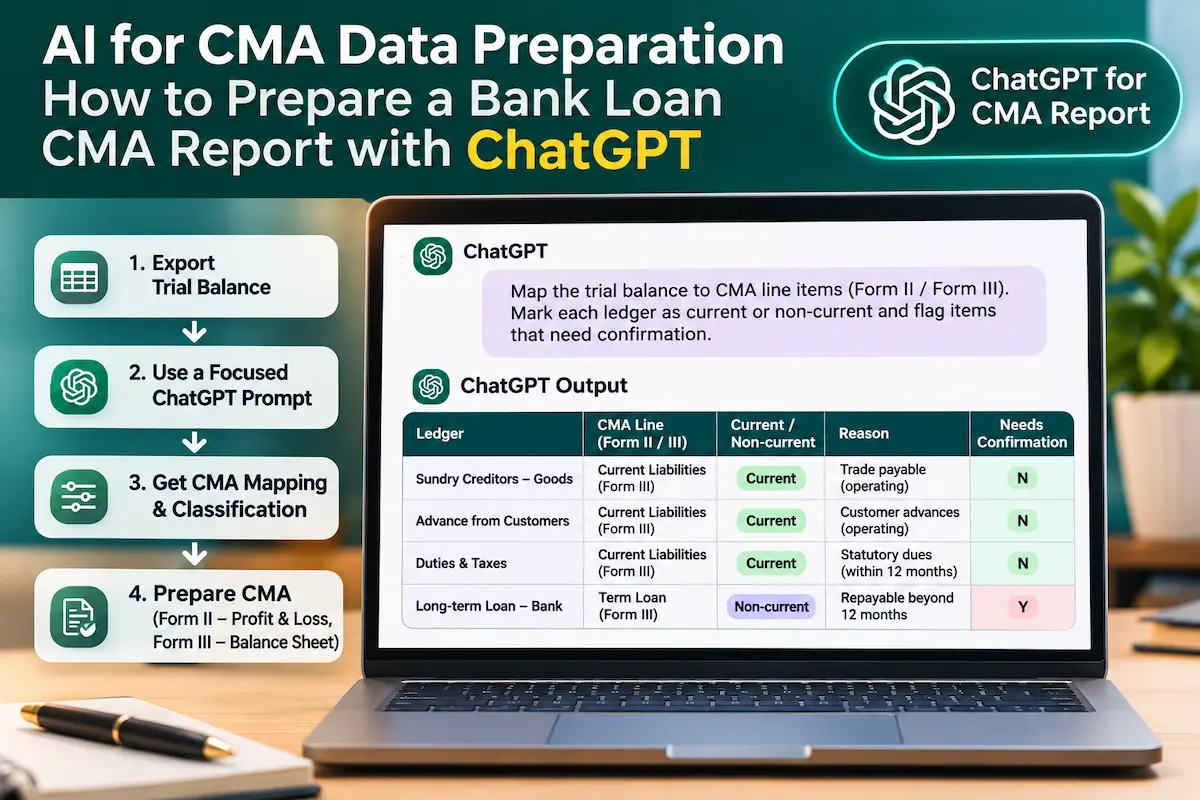
Let AI argue with your projections before the bank does
Calculate the historical ratios in Excel first: sales growth, gross margin, stock days, debtor days and creditor days. Then paste those ratios, not the raw books, and ask ChatGPT to challenge the projection you plan to use.
If AI asks why sales jump 35% when the past three years grew at 10%, you need an answer on paper. That answer becomes part of your note to the bank in Step 6.
Ask for Excel formulas, then check them against your layout
This is where AI saves the most time without touching your figures. Describe your sheet layout and ask for formulas for holding levels, the working capital gap, MPBF and the turnover method.
Paste each formula, then test it on one year you can check by hand. If the template already has these calculations built in, use this prompt to understand them rather than to rebuild them.
CHECK
CA checkpoint: two rules before you go further
First, never upload a client’s name, PAN, GSTIN, bank account numbers or the full audited file into a public AI tool. Rename the entity, round the figures if needed, and follow your firm’s AI data security checklist. Second, no figure from a chat window goes into the CMA file. Every number comes from Excel, and AI only explains or questions it.
Run the turnover method and the holding-level method side by side
RBI guidance asks banks to assess working capital for MSE borrowers with fund-based limits up to ₹5 crore at a minimum of 20% of projected annual turnover. Many banks also run the traditional holding-level method and look closely when the two results differ. Calculate both in Excel, then ask AI to explain the gap.
The third question matters. AI will often suggest raising stock days to inflate the limit. A good CA uses that answer to explain to the client why it is a bad idea.
Get a ratio review before the file leaves your office
Paste the ratio sheet from Excel and ask for a credit-officer review. Banks commonly look for a current ratio of about 1.33 under the second method, a reasonable TOL/TNW and, where a term loan exists, a DSCR of around 1.25 or more. Each bank’s own credit policy sets the exact numbers, so treat these as starting points.
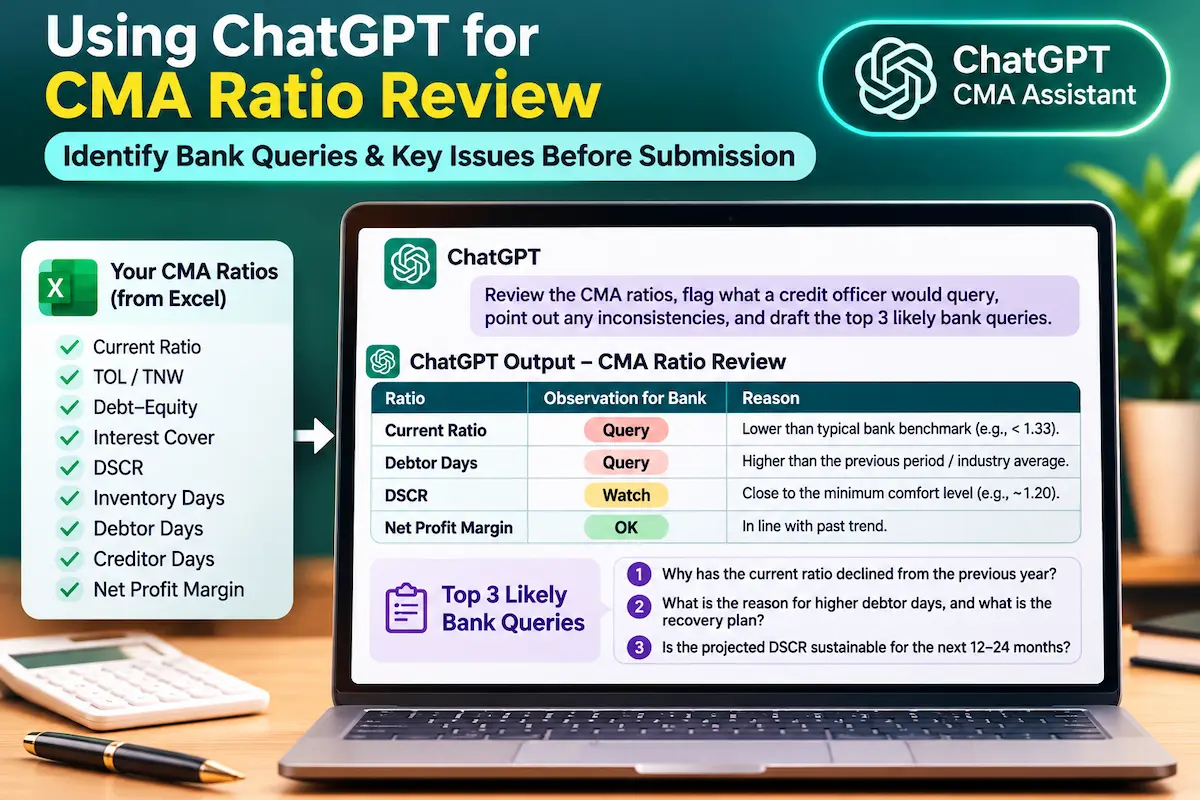
For a deeper ratio review, the Financial Ratio Analysis Template covers liquidity, leverage and turnover ratios in one sheet.
Draft the assumptions note that travels with the file
A short covering note answers questions before they are asked. It should explain the basis for growth, the holding levels, the limit requested and any ratio below the usual benchmark.
The [CONFIRM] tags are deliberate. They stop AI from filling a gap with a guess, which is the most common way a fabricated number slips into a bank file.
A Worked Example: A Delhi Distributor Asking for a ₹2.5 Crore CC Limit
Here is how the workflow played out for a typical case. A Delhi-based FMCG distributor, run as a partnership, projects sales of ₹12 crore for FY 2027-28. The partners want a cash credit limit of ₹2.5 crore. Their gross margin is 12%, they hold about 45 days of stock, give 60 days of credit and get 30 days from suppliers.
Figures in ₹ lakh · Projected FY 2027-28| Item | Basis | ₹ lakh |
|---|---|---|
| Sales | Partners’ projection | 1,200.00 |
| Cost of goods sold | 88% of sales | 1,056.00 |
| Inventory | 45 days of cost of goods sold | 130.19 |
| Receivables | 60 days of sales | 197.26 |
| Other current assets | Advances and GST input | 15.00 |
| Cash and bank | Estimate | 10.00 |
| Trade creditors | 30 days of cost of goods sold | 86.79 |
| Other current liabilities | Statutory dues and expenses | 20.00 |
| Net working capital | Long-term funds in current assets | 95.00 |
| Tangible net worth | Capital and reserves | 120.00 |
ChatGPT’s first draft of the assessment note simply took 20% of turnover and called the limit ₹2.4 crore. That is the minimum the turnover method allows, but the holding levels tell a different story.
Other current liabilities = 86.79 + 20.00 = 106.79
Working capital gap = 352.45 − 106.79 = 245.66
MPBF (Method II) = 245.66 − 25% of 352.45 (88.11) = 157.55
Bank finance actually needed = 245.66 − 95.00 = 150.66
Turnover method: 25% of 1,200 = 300.00, of which bank finance 20% = 240.00
Current ratio at ₹150.66 lakh = 352.45 ÷ 257.45 = 1.37
Current ratio if ₹240 lakh is drawn = 352.45 ÷ 346.79 = 1.02
TOL/TNW at ₹150.66 lakh = 257.45 ÷ 120.00 = 2.15
The business can only use about ₹1.51 crore of bank money on these holding levels. If the bank sanctioned ₹2.4 crore, the projected balance sheet would show net working capital of just ₹5.66 lakh. The turnover method assumes the borrower brings 5% of turnover, which is ₹60 lakh. The current ratio would also fall to 1.02, and the drawing power from actual stock and debtors would cap usage anyway.
So the honest proposal was a limit of about ₹1.55 crore, within the MPBF and backed by the holding levels, with a note that the partners would seek enhancement once the new dealer territories showed in actual sales. That gap of nearly ₹1 crore between the ask and the need is exactly what AI helped surface in Step 4. You can run the same check on your own client in the Working Capital Calculator.
Mistakes That Get CMA Data Sent Back by the Bank
Most of these errors have nothing to do with Excel skill. They come from treating CMA data preparation as form-filling instead of analysis, and preparing a CMA report with AI can repeat them faster if nobody reviews the output.
Trusting arithmetic from the chat window
AI will sometimes give a neat total that is slightly wrong, and one mistyped figure is enough to break the link between Form II and Form III. The banker usually notices before you do. Keep every calculation in Excel.
Asking for the limit first and building the numbers backwards
If the projection exists only to justify a fixed number, the holding levels and ratios will expose it quickly. Build the requirement from how the business actually runs, then compare it with the ask.
Projections with no evidence
Growth of 30% needs a reason the bank can verify, such as new orders or new territory. Use the Step 2 prompt to find these weak spots early.
Ignoring the term loan side
If the client also has or wants a term loan, the DSCR schedule matters as much as the CC limit. The DSCR and Debt Sculpting Template handles that part.
Pasting real client data into AI
This is a professional risk under your duty of confidentiality, not just a technical one, so mask the data first, every time.
AI speeds up the thinking. Excel keeps the numbers.
Good CMA data preparation is about telling the bank a consistent, believable story about the business. ChatGPT is very good at spotting where that story breaks: an odd classification, an unsupported growth rate, a limit the balance sheet cannot carry. Let it question everything, keep every figure in Excel, and sign only what you can defend in front of a credit officer.