

You’ve Probably Read That E-Invoicing Now Kicks In at ₹1 Crore. It Doesn’t. Here’s the Real ₹5 Crore Rule — and How to Use AI to Check Whether It Applies to You.
AI for GST e-invoicing is genuinely useful — but only if the number you feed it is right. Plenty of outdated content still quotes a ₹1 crore figure. The actual GST e-invoicing threshold 2026 figure is ₹5 crore, and getting it wrong in either direction costs you. Here’s what’s true, and the CChatGPT workflow I use to check it properly.
Teaching this topic starts with clearing up a genuine point of confusion. The GST e-invoicing threshold has dropped several times since it was introduced in October 2020 — from ₹500 crore, down through ₹100 crore, ₹50 crore, ₹20 crore, and ₹10 crore, landing at ₹5 crore aggregate annual turnover since 1 August 2023. There’s been real discussion in GST Council meetings about cutting it further, to somewhere around ₹1-2 crore. That discussion has not turned into a notified rule. If you’ve seen an article — or heard from someone — that e-invoicing now starts at ₹1 crore, that’s either outdated speculation or a mix-up with a different threshold entirely.
This guide shows how to use AI for GST e-invoicing checks without letting it mislead you. It covers what the ₹5 crore threshold actually means, the parts people consistently get wrong, and the ChatGPT checklist I use to confirm whether a client is covered — including the one calculation mistake that catches almost everyone once.
📑 Table of Contents
- 01The actual threshold, and how it’s calculated
- 02AI for GST e-invoicing: the four-step check
- 03Step 1 — Gather turnover across every GSTIN
- 04Step 2 — Check the eight-year lookback
- 05Step 3 — Confirm exemptions don’t apply
- 06Step 4 — Draft the compliance memo
- 07Where this goes wrong
- 08A worked example
- 09FAQ
- The GST e-invoicing threshold 2026 figure is ₹5 crore aggregate annual turnover, in force since 1 August 2023 — not ₹1 crore.
- Turnover is calculated PAN-wide, combining every GSTIN under that PAN, not GSTIN by GSTIN.
- The rule is permanent once triggered — cross ₹5 crore in any year since 2017-18, and it applies from then on, even if turnover later falls back below it.
- AI for GST e-invoicing checks is genuinely useful for gathering and verifying the numbers — it should never be the source you rely on for what the current threshold actually is, or for final e-invoicing compliance decisions.
GST E-Invoicing Threshold 2026: The Actual Figure, and How It’s Calculated
The current GST e-invoicing threshold is an aggregate annual turnover, or AATO, of ₹5 crore. It applies to B2B invoices, exports, and supplies to SEZs — not to ordinary B2C retail sales. Once your business reaches ₹5 crore turnover in a financial year, e-invoicing through the government’s Invoice Registration Portal becomes mandatory for those transaction types.
Two details trip up almost everyone doing this calculation for the first time. The turnover test is done at the PAN level, not the GSTIN level. If you run three GSTINs under one PAN, their turnovers get added together before checking against ₹5 crore — even if each individual GSTIN is well under that figure on its own. And the test looks back across every financial year since 2017-18, not just the current one. Cross ₹5 crore even once in that whole window, and the obligation applies from then on — permanently, even if turnover dips below ₹5 crore in a later year.
There’s one more current rule worth knowing if your turnover is meaningfully above the threshold. Businesses with AATO of ₹10 crore or more have to report each invoice to the portal within 30 days of issuing it. Miss that window, and the portal simply won’t generate a valid invoice reference number for it — which means your buyer can’t claim input tax credit on it either.
Pro tip
A handful of business types are exempt even above ₹5 crore — banks, NBFCs, insurers, goods transport agencies, passenger transport operators, and multiplex cinemas among them. If a client falls into one of these categories, don’t skip the exemption check just because the turnover clears the threshold.

AI for GST E-Invoicing: The Four-Step Applicability Check
Four steps: gather the turnover figures, check them against the eight-year lookback, confirm no exemption applies, and write up the answer in a memo a client can actually act on. Using ChatGPT for e-invoicing checks like this helps with the gathering, the checking, and the drafting. The conclusion is always something a person signs off on.
Step 1 — Gather turnover across every GSTIN
Pulling turnover figures for every GSTIN under one PAN, across up to eight financial years, from wherever each figure happens to live — that’s the part that eats the most time. Before any actual judgement call even gets made.
Where ChatGPT helpsOnce I’ve pulled the raw figures myself, I ask ChatGPT to lay them out clearly and total them correctly by year and by PAN — a formatting and arithmetic check, not a research task.
The promptStep 2 — Check the eight-year lookback
Once the combined figures are laid out, someone has to actually scan every year back to 2017-18 for a single year where ₹5 crore was crossed — easy to do properly, easy to accidentally skip a year while doing it quickly.
What ChatGPT doesWith Step 1’s table ready, I ask ChatGPT to confirm the earliest year the threshold was crossed, if any, and state the applicability conclusion plainly.
What I ask forCHECK
REQ’D
What I still check by hand
ChatGPT’s conclusion is only as reliable as the turnover figures I gave it in Step 1. I re-verify at least the flagged crossing year against the actual GSTR-3B or audited financials before treating the applicability conclusion as final — a transposed digit in the raw data produces a confident, wrong answer.
Step 3 — Confirm exemptions don’t apply
Checking whether a client’s specific business activity falls into one of the notified exempt categories means knowing the current exemption list and matching it against what the business actually does — not always obvious from a company name alone.
Handing it to ChatGPTI describe the business activity and ask ChatGPT to flag whether it resembles any commonly exempt category, as a prompt to check further — never as the final word on an exemption.
Here’s the askStep 4 — Draft the compliance memo
Once applicability is confirmed one way or the other, someone has to write it up clearly enough that a client without a tax background actually understands what it means for them.
With AIWith every fact already confirmed, I ask ChatGPT to draft the client-facing memo — plain language, no hedging, since the underlying research is already done.
Word for word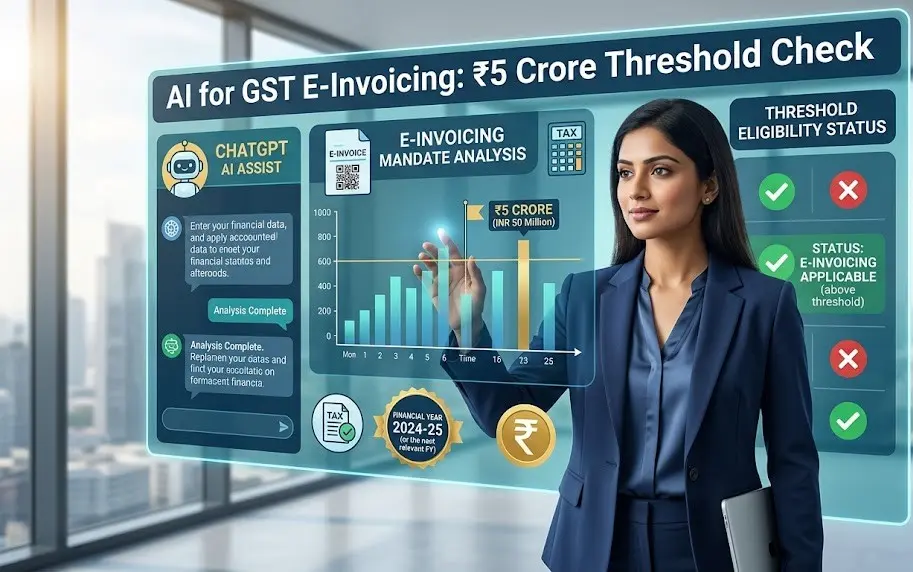
Where this goes wrong
Three mistakes come up often enough to name directly. Checking turnover GSTIN by GSTIN instead of PAN-wide. A business with three GSTINs at ₹2 crore each is at ₹6 crore combined — well over the threshold — even though no single GSTIN looks close to it on its own. Assuming a turnover drop later removes the obligation. It doesn’t. Once ₹5 crore is crossed in any year since 2017-18, e-invoicing stays mandatory going forward, regardless of what turnover does afterward. Trusting an old article or a half-remembered figure for the current threshold. This one is exactly the mix-up this guide opened with — always confirm the current number against an official CBIC notification, not a blog post, including this one, before acting on it for a real client.
A worked example
A trading company runs two GSTINs under one PAN — one in Maharashtra, one in Gujarat. Individually: Maharashtra turnover of ₹3.2 crore in FY 2024-25, Gujarat turnover of ₹2.1 crore the same year. Neither GSTIN looks anywhere near ₹5 crore on its own.
Combined at the PAN level: ₹3.2 crore plus ₹2.1 crore comes to ₹5.3 crore — over the ₹5 crore threshold. E-invoicing became mandatory for both GSTINs from that point, even though the owner had been checking each state’s numbers separately and concluding neither was covered. Step 1’s table caught this immediately once both GSTINs were laid out side by side and totalled, rather than reviewed one at a time the way the owner’s own bookkeeping had been organised.
The Threshold Itself Isn’t Complicated. Getting the Calculation Right, Across Every GSTIN and Every Year, Is.
That’s the whole GST e-invoicing threshold 2026 rule: ₹5 crore, PAN-wide, permanent once crossed. Where businesses actually get caught out is the arithmetic across multiple GSTINs and multiple years, not the concept itself. Used well, AI for GST e-invoicing speeds up gathering and checking those numbers. It doesn’t replace confirming the current official threshold before you tell a client anything about their e-invoicing compliance.