

Vendor Financial Due Diligence & Risk Assessment Excel Template
Assess supplier financial health with 3-year financial statements, key financial ratios, cash flow analysis, financial red flags and risk scoring to support informed vendor selection decisions.
How the Supplier Risk Assessment Template Works
The vendor financial due diligence Excel template provides a structured framework to evaluate a supplier’s financial strength, financial risk and overall stability before vendor selection or continuation. The Vendor Risk Assessment Template brings together three years of financial statements, financial ratios, cash-flow analysis, red flags and risk scoring to support a more consistent procurement decision.
This Supplier risk assessment template brings together three years of financial statements, financial ratio analysis, cash flow review and financial red-flag identification in one structured workflow. The analysis then converts the financial data into a vendor risk score, risk classification and procurement recommendation.
Review the Vendor Through a Structured Six-Step Process
3-Year Financial Statements → Financial Ratios → Financial Red Flags → Risk Score → Vendor Risk Classification → Procurement Recommendation
This workflow helps move from raw financial information to an actionable supplier due diligence decision, rather than relying on individual ratios in isolation.

1. 3-Year Financial Statements
Enter the vendor’s Profit & Loss, Balance Sheet and Cash Flow Statement for the latest three financial years. Reviewing multiple years helps identify financial trends rather than relying on a single year’s position.
2. Financial Ratios
Calculate key liquidity, profitability, leverage, debt-service and working-capital ratios to evaluate the supplier’s financial strength, operating performance and financial trends.
3. Financial Red Flags
Identify potential warning signs such as weak liquidity, high debt, declining profitability, negative operating cash flow and working-capital stress that may require additional review.

4. Risk Score
Combine key financial indicators using a weighted vendor financial risk scoring framework to create a consistent assessment of the supplier’s financial risk.
5. Vendor Risk Classification
Classify the supplier’s financial risk as Low, Moderate, High or Insufficient Data, based on the results of the financial assessment.
6. Procurement Recommendation
Translate the financial assessment into a practical procurement recommendation such as Approve, Approve with Conditions, Enhanced Due Diligence / Hold, or Further Information Required.
Review Pointer
Don’t assess a vendor based on a single ratio. Review the three-year trend across profitability, liquidity, leverage and cash flow, then consider the overall risk score, financial red flags and vendor risk classification before making the procurement decision.
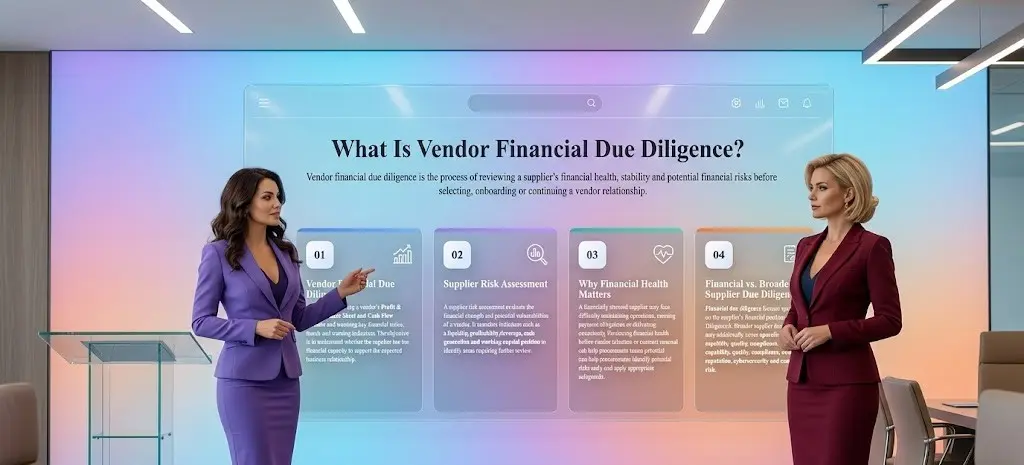
What Is Vendor Financial Due Diligence?
Vendor financial due diligence is the process of reviewing a supplier’s financial health, stability and potential financial risks before selecting, onboarding or continuing a vendor relationship.
Vendor Financial Due Diligence
It involves analysing a vendor’s Profit & Loss, Balance Sheet and Cash Flow Statement along with key financial ratios, trends and warning indicators. The objective is to understand whether the supplier has the financial capacity to support the expected business relationship.
Supplier Risk Assessment
A supplier risk assessment evaluates the financial strength and potential vulnerabilities of a vendor. It considers indicators such as liquidity, profitability, leverage, cash generation and working-capital position to identify areas requiring further review.
Why Financial Health Matters
A financially stressed supplier may face difficulty maintaining operations, meeting payment obligations or delivering consistently. Reviewing financial health before vendor selection or contract renewal can help procurement teams identify potential risks early and apply appropriate safeguards.
Financial vs. Broader Supplier Due Diligence
Financial due diligence focuses specifically on the supplier’s financial position and financial risk. Broader supplier due diligence may additionally cover operational capability, quality, compliance, ownership, reputation, cybersecurity and commercial risk.
Financial due diligence provides an important financial-risk layer within the broader supplier evaluation process. It helps turn financial information into a more consistent and evidence-based procurement assessment.

What This Vendor Financial Due Diligence Excel Template Includes
The template brings together the key financial checks needed to evaluate a supplier’s financial strength before onboarding or continuing a vendor relationship. It combines financial statement analysis, ratio analysis, risk indicators and decision-making in one practical Excel framework.
The following components work together to provide a consistent supplier risk assessment and support a more informed procurement decision.
3-Year Financial Statement Analysis
Review the vendor’s Profit & Loss, Balance Sheet and Cash Flow Statement over three years to understand financial performance, position and underlying trends.
Supplier Financial Ratio Analysis
Evaluate key liquidity, profitability, leverage, efficiency and debt-service ratios to assess the vendor’s financial health and ability to meet its obligations.
Financial Red Flag Assessment
Identify potential warning signs such as weak liquidity, rising debt, declining margins, negative operating cash flow and working-capital pressure.

Vendor Financial Risk Score
Convert the key financial indicators into a structured risk score, allowing vendors to be assessed using a consistent financial risk framework.
Supplier Risk Classification
Translate the overall risk assessment into a clear Low, Moderate, High or Insufficient Data risk classification.
Procurement Decision Dashboard
Connect the financial assessment to a practical vendor selection recommendation, such as approval, conditional approval, enhanced due diligence or further information required.

Key Financial Ratios Used in Vendor Risk Assessment
Financial ratios help convert a supplier’s financial statements into measurable indicators of liquidity, profitability, leverage, debt-servicing capacity and working-capital efficiency. Rather than relying on a single metric, the template reviews multiple indicators and their three-year trends to provide a balanced view of the vendor’s financial health.
Liquidity Ratios
Assess whether the supplier has sufficient short-term resources to meet its current obligations.
Leverage & Solvency
Evaluate the vendor’s reliance on debt and the strength of its overall financial structure.
Debt Serviceability
Assess the supplier’s capacity to meet interest and scheduled debt repayment obligations.
Profitability Ratios
Determine whether the vendor is generating sustainable profits and returns from its operations.
Cash Flow Ratios
Compare reported profitability with actual cash generation from the supplier’s operations.
Working Capital Ratios
Identify potential liquidity pressure arising from receivables, inventory and supplier payment cycles.
A financially strong vendor should not be judged by one ratio alone. Review the three-year trend, combination of ratios and underlying financial red flags before reaching a supplier risk conclusion.
How the Vendor Financial Risk Score Is Calculated
A supplier’s financial position cannot be assessed reliably using a single financial ratio. The template combines six key financial drivers and assigns a different weight to each based on its relevance to vendor financial risk assessment.
Each driver receives an individual score, which is multiplied by its assigned weight to calculate the overall vendor financial risk score.
Debt Serviceability
Measures the vendor’s capacity to meet scheduled debt-service obligations.
Liquidity
Assesses the supplier’s ability to meet its short-term financial obligations.
Cash Flow Quality
Indicates how effectively reported profits are converted into operating cash.
Leverage
Shows the extent to which the vendor relies on debt relative to its equity base.
Working Capital
Highlights the efficiency of receivables, inventory and supplier payment cycles.
Profitability
Indicates the proportion of revenue retained as profit after operating and other expenses.
From Financial Data to Vendor Risk Score
Vendor Risk Classification
The overall score is used alongside financial red flags and data quality to support the supplier assessment.
The risk score provides a structured financial assessment, but it should be considered alongside financial red flags, data quality, vendor exposure and broader supplier due diligence before making a procurement decision.

Financial Red Flags in Vendor Due Diligence
Financial ratios provide measurable indicators of a supplier’s financial position, but financial red flags help identify areas that may require closer attention. A strong supplier risk assessment should look beyond individual ratios and consider changes in profitability, liquidity, leverage, cash flow and working capital over time.
The template helps highlight potential warning signals and deteriorating financial trends, allowing procurement and finance teams to identify vendors that may require additional review before selection or contract renewal.
These indicators should not automatically result in rejection. They are signals for further investigation and should be evaluated alongside the vendor’s overall financial position, business context and other supplier due diligence findings.
| Financial Red Flag | What to Look For |
|---|---|
Declining Revenue | Persistent fall in revenue or loss of major customers. |
Margin Compression | Declining EBITDA or net profit margins over the review period. |
Liquidity Stress | Weak current ratio or increasing short-term financial obligations. |
High Leverage | Rising debt-to-equity or excessive net debt relative to operating earnings. |
Weak Cash Generation | Operating cash flow consistently below reported accounting profit. |
Working Capital Stress | Rising receivable or inventory days, or a prolonged cash conversion cycle. |
Pro-Tips: A single red flag does not necessarily indicate financial distress. Look for persistent deterioration across multiple indicators, unusual year-on-year movements and combinations of red flags before escalating a vendor for enhanced due diligence.


Vendor Risk Classification
The financial analysis and red-flag assessment are consolidated into an overall vendor risk classification, helping procurement and finance teams interpret the supplier’s financial position and identify where additional review may be required.
Low Risk
Strong financial position with limited indicators of financial stress.
Moderate Risk
Generally acceptable position, but certain areas require monitoring or appropriate conditions.
High Risk
Multiple financial concerns or deteriorating trends warrant enhanced due diligence before proceeding.
Insufficient Data
Financial information is incomplete, inconsistent or inadequate for a reliable conclusion.
Risk classification should be interpreted together with the underlying ratios and financial red flags. A high-risk classification does not automatically mean the vendor should be rejected; it may indicate the need for additional information, safeguards or management review.
Procurement Recommendation Based on Financial Risk
The purpose of vendor financial due diligence is not simply to calculate ratios. The analysis should help procurement teams determine what action to take based on the supplier’s financial risk profile.
The template converts the financial assessment into a practical procurement recommendation, while allowing appropriate safeguards where the vendor presents manageable but identifiable financial risks.
Recommended Procurement Outcomes
Approve
Vendor demonstrates an acceptable financial position with no significant financial concerns identified.
Approve with Conditions
Vendor may be suitable, but specific safeguards or commercial conditions should be considered.
Enhanced Due Diligence / Hold
Financial concerns require additional investigation before the vendor is approved.
Further Information Required
Available financial information is insufficient to reach a reliable conclusion.
Financial risk should be one component of the overall supplier selection process. Procurement teams should also consider operational capability, quality, compliance, commercial terms, concentration risk and other relevant due-diligence factors.

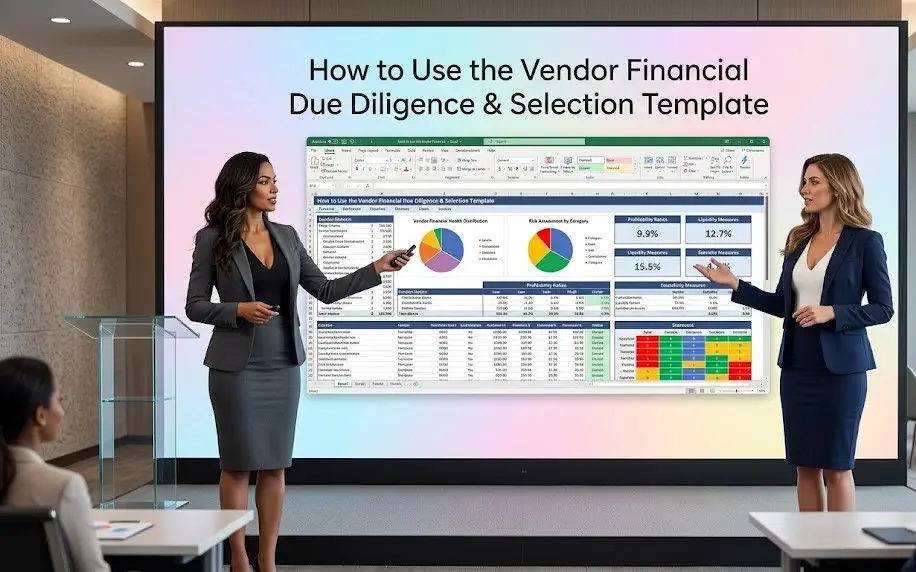
How to Use the Vendor Financial Due Diligence & Selection Template
Follow the six-step workflow below to move from vendor information and financial statements to financial risk assessment and procurement decision. The template is designed to make the vendor review process structured, consistent and easier to document. Start by entering the vendor’s key information and three years of financial data, then review the automatically calculated ratios and risk indicators. The final dashboard brings these findings together into a clear view of the vendor’s financial position and overall risk.
Step 1 — Vendor Profile
Enter the vendor’s key details, Proposed Annual Order Value, scoring weights and decision thresholds.
Step 2 — P&L, Balance Sheet & Cash Flow
Enter the vendor’s latest three years of financial statements in the designated input cells using audited accounts, annual reports or RFP/RFQ submissions.
Step 3 — Check the Balance Sheet
Confirm that the Balance Check shows 0 for all three years before relying on the analysis.

Step 4 — Financial Ratios
Review the automatically calculated ratios covering solvency, profitability, cash flow, debt serviceability, working capital and concentration risk.
Step 5 — Risk Assessment & Scoring
Review the financial data quality, red flags, weighted risk score and risk classification. DuPont Analysis and Altman Z-Score provide additional analytical context.
Step 6 — Vendor DD Dashboard
Use the dashboard’s decision banner, KPI snapshot and three-year trends to present the vendor’s financial risk position and support the procurement decision.
Complete the steps in sequence to ensure the final vendor risk assessment and procurement recommendation are based on consistent and validated financial information.

Download the Vendor Financial Due Diligence Excel Template
Assess supplier financial strength, identify potential financial risks and support more consistent vendor selection decisions with a structured three-year financial due diligence framework.
Excel Template • Vendor Risk Assessment • Supplier Due Diligence
Frequently Asked Questions
Use the template as a financial-risk assessment layer within your broader supplier evaluation process. The final procurement decision should consider financial findings together with commercial, operational, compliance and other relevant vendor risks.

Explore More Excel Templates & Financial Models
Explore our collection of free Excel templates, financial models and financial analysis tools designed for practical finance and business needs. Find ready-to-use resources for financial ratio analysis, financial statements, project finance, budgeting, forecasting, cash flow management, loan analysis, investment evaluation and business planning—all created to simplify financial analysis and support better financial decision-making.
SME Financial Excel Templates & Utilities
- ROI Excel Template (Free Download) – Financial Model
- SME Financial Dashboard Excel Template (Free KPI Tracker)
- Free Financial Model Excel Template -Track Your Business KPI
- 13 Week Cash Flow Forecast Excel Template – Track Cash Weekly
- Free Startup MIS Dashboard Excel Template with KPI Dashboard
- Budget vs Actual Excel Template (Free Download) for SMEs
- Accounts Receivable and Payable Tracker Excel Template – Free
- Payroll Salary Register Excel Template (Free Download)
- Bid Evaluation Financial Model Excel Template (Free Download)
- BESS Financial Model Excel Template – Free Project Finance Model
- Free DSCR Debt Sculpting Excel Template | Project Finance Model
- Inventory Management Excel Template – Free Download
- Break Even Analysis Excel Template – Free Excel Download
- Monthly Financial Statement Excel Template with Ratios
- Financial Ratio Analysis Excel Template – 28+ Ratios

Stay Updated with New Financial Excel Templates & Tools
Disclaimer
This Vendor Financial Due Diligence & Risk Assessment Excel Template is provided for educational, analytical and planning purposes only. The template uses user-entered vendor financial information and standard financial analysis principles to calculate and present financial ratios, risk indicators, red flags, risk scores and vendor risk classifications. Actual financial risk may vary due to differences in accounting policies, industry characteristics, business conditions, financial data quality and other commercial or market factors.
Risk classifications, benchmark ranges and procurement recommendations are provided for general analytical guidance only and should not be considered definitive standards or automatic grounds for vendor approval or rejection. Users should independently verify the underlying financial information, formulas, assumptions and assessment results and consider relevant commercial, operational, legal, compliance and other supplier risks before making vendor selection, onboarding, contracting or continuation decisions. The template does not constitute financial, investment, credit, legal or procurement advice.