
Introduction
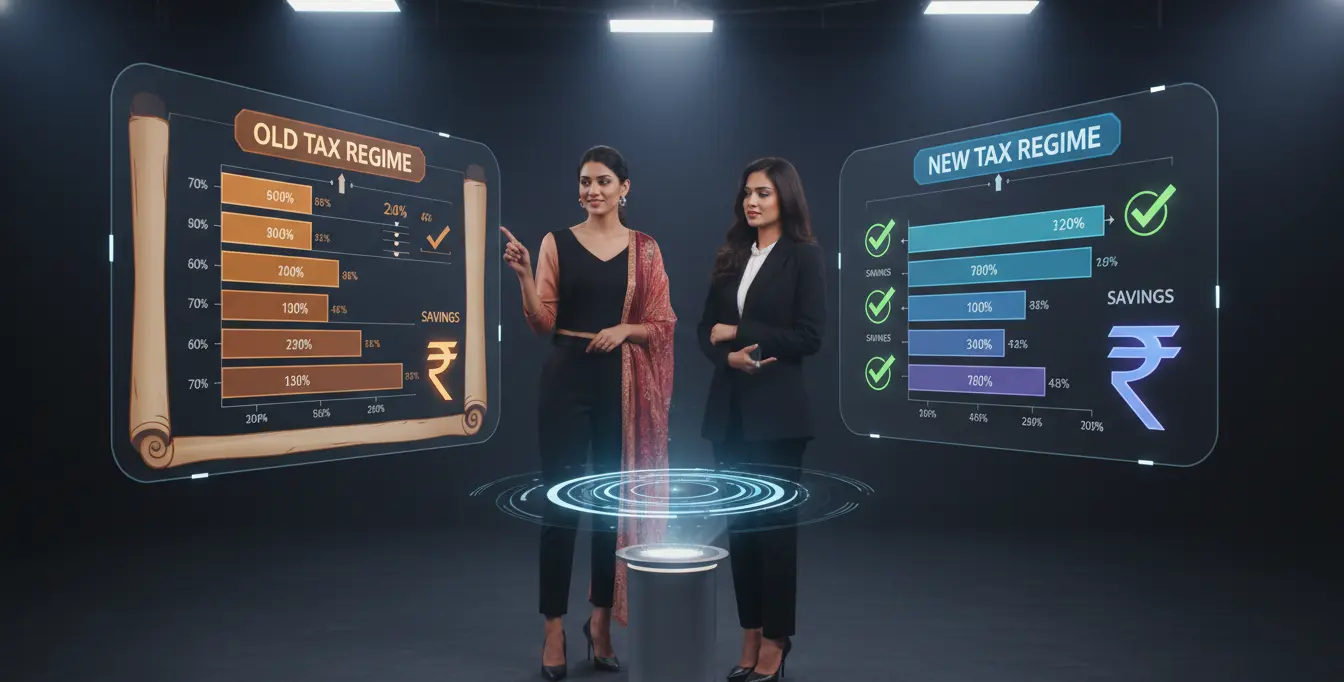
Many salaried taxpayers now use AI for Old vs New Tax Regime comparison before deciding which tax option is better for them. Instead of relying only on spreadsheets, online calculators, or manual estimates, AI can analyse your salary structure, deductions, exemptions, and tax-saving opportunities in minutes—making tax comparison faster, smarter, and more personalised.
Choosing between the Old Tax Regime and the New Tax Regime is not always straightforward. Your salary break-up, HRA claim, home loan interest, Section 80C investments, health insurance premium, employer’s NPS contribution, and other taxable income can significantly influence which regime is more beneficial.
This is where tools like ChatGPT, Claude, and Gemini can genuinely help. When used correctly, AI can compare both tax regimes side by side, explain the difference in tax liability, highlight deductions that matter most, and even identify additional tax-saving opportunities you may have overlooked.
However, AI is only as good as the information you provide. Incomplete salary details, missing deductions, or incorrect assumptions can lead to misleading results. In this guide, we will see how to use AI for Old vs New Tax Regime comparison in India, including what information AI needs, the best prompts to use, and how to verify whether AI’s recommendation is reliable under FY 2025–26 (AY 2026–27) tax rules.
What You Need Before Asking AI
Before asking AI to compare the Old vs New Tax Regime, gather your income, exemptions, and deduction details in one place. A good tax comparison depends on accurate inputs—if key information is missing, AI may suggest the wrong option.
Keep these details ready:
✅ Salary break-up – Basic pay, HRA, taxable allowances, bonus / incentive
✅ Exempt allowances – LTA, meal allowance, phone / internet reimbursement, and similar exempt components (if applicable)
✅ Perquisites – Company car, employer-paid benefits, ESOP taxable value, or other taxable perks (if any)
✅ Rent paid – Monthly rent and whether your city is metro / non-metro
✅ Tax-saving deductions – 80C, 80D, education loan interest, eligible donations, etc.
✅ Home loan details – Interest paid and principal repayment
✅ Employer NPS contribution – Eligible deduction under Section 80CCD(2)
✅ Other income – Interest, rental income, capital gains, freelance income, or any additional taxable income
Once you have these numbers ready, AI can make a much smarter and more personalised tax comparison. The next step is knowing what prompt to give AI—and that is where the real magic begins.

Best AI Prompt for Old vs New Tax Regime Comparison
Once your financial details are ready, the next step is framing the prompt correctly. The quality of AI’s recommendation depends heavily on how clearly you define its role, the tax year, the comparison method, and the output you expect. A detailed prompt helps AI behave more like a tax analyst than a general chatbot.
To make things easier, here is a ready-to-use AI prompt that you can simply copy, paste, and customise with your own financial details for a personalised Old vs New Tax Regime comparison.
📌 Ready-to-Paste AI Prompt
Copy the prompt below, paste it into ChatGPT (or any AI tool), and replace the sample numbers with your own financial details for a personalised tax regime comparison.
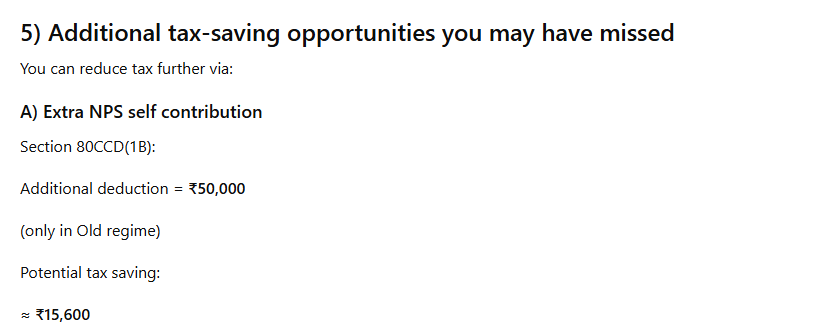
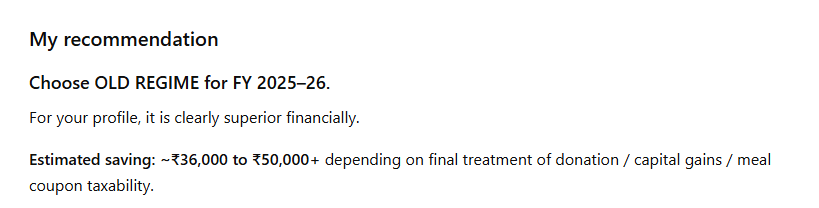
Once you run this prompt, AI will generate a personalized comparison of both tax regimes based on your financial details. You can further refine the analysis by asking follow-up questions on deductions, exemptions, or tax-saving opportunities. Refer below the few screenshots of AI recommendation.
Advanced AI Prompt for Better Tax Planning
The first prompt helps compare the Old and New Tax Regime based on your current financial details. However, one of the biggest advantages of AI is that it can also test multiple “what-if” scenarios and help you optimise your tax position before the financial year ends.
For example, you can ask AI:
- What happens if I increase my NPS contribution?
- Will a higher rent claim improve my tax savings?
- Should I increase health insurance cover for additional deduction?
- Does prepaying home loan principal make sense?
- What salary restructuring options can reduce tax liability?
To explore such scenarios, use the advanced prompt below.
📌 Copy & Paste Prompt for Advanced Tax Planning
Use this advanced prompt to ask AI different “what-if” tax planning questions and discover smarter ways to optimise your tax position under both regimes.
AI is particularly useful here because it can instantly model multiple scenarios that would otherwise require repeated manual calculations. This makes tax planning more proactive rather than reactive

How AI Compares Both Tax Regimes
After running the prompt, AI will usually provide a side-by-side comparison showing estimated tax under both regimes, deductions considered, and its recommendation based on your financial profile. The real benefit is not just the final answer—it is understanding why one regime is better than the other.
In the above example, AI analysed salary structure, HRA eligibility, exempt allowances, home loan benefits, tax-saving deductions, employer NPS contribution, and other taxable income before comparing both regimes.
What AI Identified
✅ Old Tax Regime appears more beneficial for the sample profile
✅ Higher deductions and exemptions significantly reduced taxable income
✅ HRA exemption + home loan interest + Section 80C + Section 80D created meaningful tax savings
✅ Employer NPS contribution further improved tax efficiency
✅ Additional planning opportunities (such as extra NPS contribution) could reduce tax further
AI Recommendation
For the sample profile used in this article, AI recommended choosing the Old Tax Regime for FY 2025–26, as the overall tax outgo was lower compared with the New Tax Regime.
Key Learning
AI does more than compare numbers—it helps explain which deductions are creating the tax advantage. This makes tax planning easier, more transparent, and more personalised.
Important: AI recommendations should be treated as a smart first-level analysis. Before making your final regime selection, always verify the output against the latest tax rules and your actual financial documents.
How to Check if AI’s Tax Advice Is Correct
AI can analyse tax scenarios quickly, but it should not be treated as the final authority without verification. A small mistake in inputs, a missed deduction, or an incorrect assumption about tax rules can change the final recommendation. That is why a quick review is essential before relying on AI’s output.
Use this simple 3-step check:
1) Verify Your Inputs
Check whether you entered the correct:
✅ Salary break-up
✅ HRA and rent details
✅ Exempt allowances
✅ Tax-saving deductions (80C / 80D / others)
✅ Home loan interest and principal repayment
✅ Employer NPS contribution
✅ Other taxable income (interest, rent, capital gains)
Even a small missing figure can distort the comparison.
2) Ask AI to Explain Its Calculation
Do not stop at the recommendation. Ask follow-up questions like:
Which deductions reduced my taxable income the most?
Did you consider HRA exemption correctly?
How did you treat home loan interest?
What assumptions did you make while comparing both regimes?
This helps you understand the logic behind AI’s answer.
3) Cross-Check With a Tax Calculator or Professional
As a final step, compare AI’s output with:
✅ A reliable income tax calculator
✅ Your Form 16 workings
✅ Advice from a qualified tax professional (if tax impact is material)
AI is excellent for quick comparison and scenario planning—but final decisions should always be based on verified numbers.
Use AI as a smart tax assistant, not as the final decision-maker.
FAQ
1) Can ChatGPT compare the Old and New Tax Regime accurately?
Yes, ChatGPT can compare both tax regimes if you provide complete salary, deduction, and exemption details. However, its output should always be verified against current tax rules and your actual financial documents.
2) What details should I give AI for tax regime comparison?
You should provide salary break-up, exempt allowances, perquisites, rent details, tax-saving deductions, home loan details, employer NPS contribution, and other taxable income for a meaningful comparison.
3) Can AI suggest ways to reduce my tax liability?
Yes. AI can identify missed deductions, highlight salary restructuring opportunities, and model different tax-saving scenarios based on your financial profile.
4) Is AI better than an online tax calculator?
A tax calculator gives a quick numerical result, while AI can analyse your complete financial picture, explain the reasoning, and answer follow-up questions. Both work best when used together.
5) Should I rely only on AI for tax decisions?
No. AI should be used as a smart analysis tool. Final tax decisions should always be based on verified numbers, updated tax laws, and professional advice where needed.
Final Thoughts: AI Can Make Tax Decisions Smarter
Comparing the Old Tax Regime and New Tax Regime is no longer limited to spreadsheets, manual calculations, or rough estimates. With the right prompt and accurate financial inputs, AI can analyse your salary structure, deductions, exemptions, and tax-saving opportunities in minutes—making the comparison faster, smarter, and more personalised.
The real strength of AI is not just tax calculation. It can help you:
✅ compare both tax regimes side by side
✅ identify deductions or exemptions you may have overlooked
✅ test different tax-saving scenarios instantly
✅ understand why one regime is better than the other
✅ make more informed financial decisions
However, one principle always remains important—better inputs create better outputs. The quality of AI’s recommendation depends on how accurately you provide your salary, deduction, and income details.
Used wisely, AI can become a powerful assistant for tax planning and regime comparison—helping taxpayers make decisions with greater clarity and confidence.
In short:
Don’t just ask AI which tax regime is better—give AI the right data, ask the right questions, and use its insights to make a smarter tax decision

Related Articles
- How to Calculate ROI for Business Investments Using Excel and AI Analysis
Evaluate whether your business decisions are actually generating returns using structured ROI analysis. - Cash Flow Forecasting for Small Businesses Using Excel and AI
- How to Build a Financial Model for SMEs Using Excel and AI
- AI for GST Reconciliation in India: Fix GSTR-2B Mismatch
- AI for Tax Planning in India: How to Use AI for Tax Saving