

GST Filing Week Reality: Why Reconciliation Suddenly Becomes Urgent
In most SMEs, GST reconciliation starts only 1–2 days before filing — not during the month.
That’s when the problem shows up.
The ITC as per books doesn’t match with GSTR-2B.
Some invoices are missing.
Some vendors haven’t filed returns.
And suddenly, everything has to be reconciled in a few hours.
And at that point, there’s no room for error.
In my experience, this is not a GST issue — it’s a timing issue.
By the time mismatches are identified, there’s hardly any time left to fix them, which is where ITC errors usually happen.
This is where AI for GST reconciliation in India can actually help — not by changing the process, but by helping you identify mismatches faster when time is limited.
This article focuses on why this mismatch happens, why it becomes difficult to fix during filing, and how AI can be used practically in the GST reconciliation process without changing your existing GST workflow.
The Real Problem: GSTR-2B vs Books Mismatch Appears Just Before Filing
The most common issue in the GST reconciliation process is not complexity — it’s timing.
During the month, purchase entries are recorded in books, and Input Tax Credit (ITC) starts accumulating. But GSTR-2B reconciliation is rarely done alongside, even though it reflects ITC based on vendor filings.
As a result, two numbers keep moving separately:
- ITC as per books
- ITC as per GSTR-2B
And they are assumed to match.
The mismatch only becomes visible when GST reconciliation in India is actually performed — usually just before filing.
At that point, differences start showing up:
- invoices recorded in books but missing in GSTR-2B
- vendors who have not filed GSTR-1
- incorrect GSTIN or invoice details
- timing differences affecting the GST reconciliation process
In practical terms, this is where the confusion begins.
In many SME cases, it’s common to see a ₹1–2 lakh difference between books and GSTR-2B reconciliation just before filing. And without proper tracking during the month, there’s no clarity on:
- how much eligible ITC can actually be claimed
- which vendors require follow-up
- whether the mismatch is temporary or permanent
This is why GST reconciliation in India suddenly becomes a high-pressure activity.
Not because the data is unavailable — but because it is reviewed too late.
And this is exactly where AI for GST reconciliation in India can support the process — by quickly comparing GSTR-2B vs books, identifying mismatches, and bringing clarity to what would otherwise take hours to analyse manually.
Why GST Errors Found on Filing Day Are Risky and Hard to Fix
The biggest misconception in the GST reconciliation process is this:
👉 mismatches can be fixed at the time of filing.
In reality, once a GSTR-2B vs books mismatch is identified on filing day, your options are already limited.
The first problem is time.
By the time reconciliation starts, there are only a few hours left before filing. There is no practical window to:
- verify each mismatch
- check invoice-level details
- analyse whether the difference is temporary or permanent
The second problem is vendor dependency.
If an invoice is missing in GSTR-2B, it usually means the supplier has not filed GSTR-1 or has filed it incorrectly. And this is something you cannot fix from your end — especially on the last day.
Even if you identify the issue:
- vendors may not respond immediately
- corrections cannot be reflected instantly
- the impact on Input Tax Credit (ITC) remains uncertain
The third problem is decision pressure.
At this stage, you are forced to take quick calls:
- claim ITC and risk future reversal
- or skip ITC and affect working capital
Neither option is ideal — but both are common in last-minute GST reconciliation in India.
This is why errors identified at the time of filing are not just operational issues — they become financial decisions.
And this is where most businesses struggle.
Not because they don’t understand GST,
but because the GST reconciliation process starts too late.
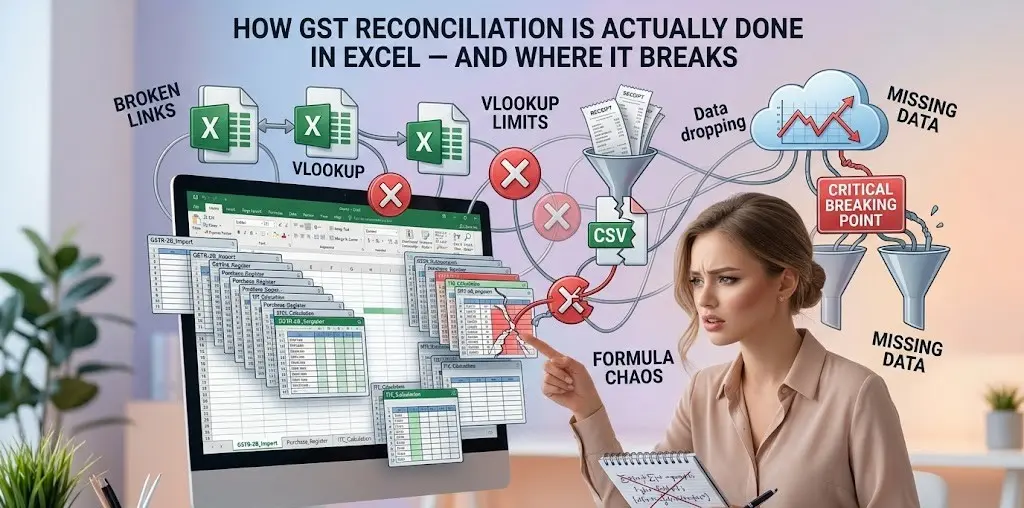
How GST Reconciliation is Actually Done in Excel — And Where It Breaks
In most SMEs, the GST reconciliation process is still done in Excel.
The typical approach is simple:
- download GSTR-2B
- export purchase register
- match invoices line by line
At first, this looks manageable. But as data volume increases, the process starts breaking.
The biggest issue is manual matching.
Invoice numbers may not align exactly, GSTIN errors are common, and formats differ between books and GSTR-2B reconciliation data. Even small inconsistencies can lead to mismatches being missed.
The second issue is time.
Reconciling a few hundred invoices can easily take 3–5 hours, especially when done close to filing. Under pressure, the risk of skipping entries or making incorrect matches increases.
The third issue is lack of visibility.
Excel shows data, but it doesn’t highlight patterns — like repeated vendor issues or consistent GSTR-2B vs books differences.
This is where the traditional approach starts failing — not because Excel is wrong, but because the process is too manual for the volume and timing involved.
The Biggest GST Mistake I See Before Every Filing Deadline
Across most SME cases, the biggest issue is not data — it’s behaviour.
The GST reconciliation process is treated as a last-day activity instead of a monthly discipline. Businesses assume that GSTR-2B reconciliation will match automatically, without actively tracking vendor filings.
This creates a false sense of comfort.
By the time reconciliation actually starts, the gap between GSTR-2B vs books is already there — just not visible earlier.
Another common mistake is blind reliance on vendors.
If a supplier delays or files incorrectly, it directly impacts your Input Tax Credit (ITC). But most businesses only realise this at the time of filing, when there’s no time left to act.
In my experience, the problem is rarely about lack of tools.
It’s about:
- delayed visibility
- reactive approach
- and no structured reconciliation during the month
And that’s why the same issue repeats every month in GST reconciliation in India.
How AI Quickly Identifies Missing Invoices and ITC Mismatches
The role of AI for GST reconciliation in India is not to replace the process — but to speed up the most time-consuming part: data comparison.
Instead of manually matching GSTR-2B vs books, AI can analyse both datasets together and highlight mismatches in seconds.
What usually takes hours in Excel — scanning invoice by invoice — becomes much faster because AI focuses directly on exceptions.
It can quickly identify:
- invoices present in books but missing in GSTR-2B
- vendor-wise mismatches
- differences in Input Tax Credit (ITC)
- repeated errors in the GST reconciliation process
The biggest advantage is clarity.
Instead of going through the entire data, you immediately see where the problem lies. This makes reconciliation more focused, especially when time is limited.
AI does not change how GST works — it simply makes GSTR-2B reconciliation faster and more manageable.

Step-by-Step: How to Match GSTR-2B with Books Using AI
Start with clean data. Export GSTR-2B and your purchase register in Excel. Ensure basic consistency — GSTIN format, invoice numbers, and dates should be standardised before comparison.
Next, upload both files into a tool like ChatGPT or Claude. At this stage, the role of AI is simple — to compare both datasets and highlight mismatches faster than manual Excel review.
However, AI does not automatically know what to look for.
👉 You need to clearly tell it what kind of mismatches you want to identify.
This is where a structured prompt becomes important.
Instead of manually scanning hundreds of invoices, you can direct the AI to focus only on relevant differences.
👉 Use this prompt to compare GSTR-2B with your books:
Compare GSTR-2B with purchase register Identify:
- Missing invoices in GSTR-2B
- ITC mismatch amount
- Vendor-wise differences Highlight:
- Top 5 vendors causing mismatch
- High-value discrepancies Present the output in a clear table with summary insights
Once the comparison is done, the next step is not just identifying mismatches — but understanding patterns behind them.
For example, repeated vendor errors or consistent ITC gaps can indicate deeper issues in the GST reconciliation process.
👉 To analyse this further, you can use a second prompt:
Analyse this GST reconciliation data- Identify repeated vendor errors
- Detect unusual ITC patterns
- Suggest actions to reduce mismatches Provide a short summary with priority actions
This approach shifts your role from manual matching to decision-making, making the GSTR-2B vs books reconciliation process faster and more focused — especially during filing deadlines.
From 4 Hours to Under 60 Minutes: What Actually Changes with AI
In a typical setup, manual GST reconciliation in Excel takes 3–5 hours, especially when done close to filing. Most of that time goes into scanning data and trying to locate mismatches in GSTR-2B vs books.
With AI for GST reconciliation in India, that effort shifts from searching to reviewing.
Instead of going through every invoice, AI highlights the exact problem areas — missing invoices, vendor-wise gaps, and differences in Input Tax Credit (ITC).
The time reduction is significant:
- manual matching → 3–5 hours
- AI-assisted review → 30–60 minutes
But the bigger change is control.
You’re no longer guessing where the mismatch is. You see it clearly and can act faster — whether it’s vendor follow-up or ITC adjustment.
This makes the overall GST reconciliation process more focused, especially during filing timelines when time is limited.
Why AI Cannot Fix Vendor Non-Filing (And Why That Matters Most)
While AI for GST reconciliation in India can speed up the GST reconciliation process, it cannot solve the biggest dependency — vendor compliance.
If an invoice is missing in GSTR-2B, it usually means the supplier has not filed GSTR-1 or has filed it incorrectly. This directly impacts your Input Tax Credit (ITC), and no tool can correct that from your side.
AI can highlight the issue instantly, but it cannot:
- force vendors to file returns
- correct their data
- update GSTR-2B reconciliation in real time
This limitation is important.
Because in most cases, the root cause of GSTR-2B vs books mismatch is not internal — it’s external.
What AI does is give you early visibility.
And that’s the real advantage — you can identify vendor issues sooner, follow up in time, and avoid last-day surprises.
Final Takeaway: Fix GST Reconciliation During the Month, Not on Filing Day
The issue in the GST reconciliation process is not lack of data — it’s lack of timing.
When reconciliation is delayed until filing week, mismatches in GSTR-2B vs books become difficult to manage, and decisions around Input Tax Credit (ITC) are taken under pressure.
That’s where most errors happen.
Using AI for GST reconciliation in India does not change GST compliance rules. But it helps you identify mismatches faster and act earlier.
And that’s the real shift.
Instead of reacting at the last moment, you move towards early visibility and better control.
Even a simple change — reviewing GSTR-2B reconciliation during the month — can reduce last-day pressure significantly.
AI is not the solution by itself.
👉 The solution is fixing the workflow — and using AI to support it.

FAQs on Using AI for GST Reconciliation
How can AI be used for GST reconciliation in India?
AI can be used to compare GSTR-2B with purchase data, identify missing invoices, highlight ITC mismatches, and reduce manual effort in the GST reconciliation process. It acts as a data analysis assistant rather than replacing compliance.
What is the main benefit of using AI for GST reconciliation?
The biggest benefit is speed and clarity. Instead of manually matching invoices, AI highlights mismatches instantly, helping you focus only on problem areas during GST reconciliation.
Which AI tools can be used for GST reconciliation?
Tools like ChatGPT and Claude can be used to compare GSTR-2B with books, analyse mismatches, and summarise differences in a structured format.
Can AI automatically fix GST mismatches?
No. AI cannot fix GST mismatches or update GSTR-2B. It can only identify issues quickly. Corrections still depend on vendor filings and proper follow-up.
Is AI safe to use for GST data analysis?
AI can be used safely if sensitive data is handled carefully. Many users prefer removing confidential details before uploading data for analysis.
How much time can AI save in GST reconciliation?
AI can reduce reconciliation time from 3–5 hours to under 60 minutes by quickly identifying mismatches instead of manual invoice-level comparison.
Do SMEs in India use AI for GST reconciliation?
Currently, adoption is low. Most SMEs still rely on Excel. However, AI is increasingly being used by professionals to speed up reconciliation and reduce last-day workload.
Related Articles
- How to Calculate ROI for Business Investments Using Excel and AI Analysis
Evaluate whether your business decisions are actually generating returns using structured ROI analysis. - Cash Flow Forecasting for Small Businesses Using Excel and AI
- How to Build a Financial Model for SMEs Using Excel and AI