

Will Your Business Run Out of Cash in the Next 90 Days?
A 13 week rolling cash flow forecast Excel template for SMEs that gives clear weekly cash visibility, identifies funding gaps, calculates cash runway, and protects your business from sudden liquidity risk, vendor pressure, and revenue slowdowns — before they turn into a cash crisis.
13 Week Cash Flow Forecast Excel Template for SMEs
Cash flow problems don’t appear suddenly — they build silently.
For small and medium businesses, a 13 week rolling cash flow forecast provides weekly visibility into inflows, outflows, funding gaps, and cash runway — so you can identify liquidity risk before it disrupts salaries, vendors, or bank commitments.
Unlike traditional monthly projections, this SME cash flow forecast model focuses on short-term working capital control. It automatically calculates minimum cash position, maximum funding requirement, buffer coverage ratio, and cash runway (in weeks).
With built-in revenue sensitivity and stress testing, you can instantly see how a 10–20% drop in sales impacts liquidity — turning uncertainty into structured financial decisions.
This is not just a spreadsheet.
It is a practical liquidity management system built for growing SMEs.
What Is a 13-Week Rolling Cash Flow Forecast for SMEs?
A 13 week rolling cash flow forecast for SMEs is a short-term liquidity planning model that tracks expected weekly cash inflows and outflows over the next 13 weeks (approximately 90 days). Unlike traditional monthly cash flow statements that focus on historical reporting, this forward-looking model helps small and medium businesses monitor working capital, identify funding gaps, calculate cash runway, and assess liquidity risk in advance. Because it is updated weekly on a rolling basis, it provides continuous visibility into upcoming cash shortages, enabling business owners and finance managers to make timely decisions on expenses, collections, financing, and cost control before a cash flow crisis occurs.
Why SMEs Need a Short-Term Cash Flow Forecast Model
For most small and medium enterprises, profit does not automatically mean liquidity. Delayed receivables, rising operating costs, GST dues, loan EMIs, and vendor commitments can quietly create cash pressure even when revenue appears healthy. In practice, most liquidity crises are not caused by losses — but by poor short-term cash visibility. To bridge this gap between accounting profit and actual cash availability, SMEs need structured weekly insight into inflows and outflows. A properly designed SME cash flow forecast model provides that clarity and strengthens small business cash flow planning before financial stress escalates.
Many SMEs report accounting profits yet struggle with working capital shortages due to delayed collections and high operating cycles. A weekly cash flow forecast aligns operational reality with actual cash availability.
The model identifies specific weeks where projected balances may turn negative — helping prevent salary delays, vendor strain, GST defaults, or emergency high-cost borrowing.
Data-backed short-term projections improve credibility with lenders and suppliers. Clear liquidity planning supports working capital discussions and funding approvals.
Tracking weekly collections, expenses, debt servicing, and statutory dues transforms reactive firefighting into proactive liquidity control.
Even a 10–20% decline in revenue can reduce cash runway significantly. Built-in scenario visibility allows SMEs to assess liquidity risk before operational disruption occurs.
Instead of operating on assumptions, businesses gain a structured framework for short-term cash flow planning, liquidity risk assessment, and sustainable growth.
HOW THE SYSTEM OPERATES
How This 13-Week Cash Flow Forecast Excel Template Works
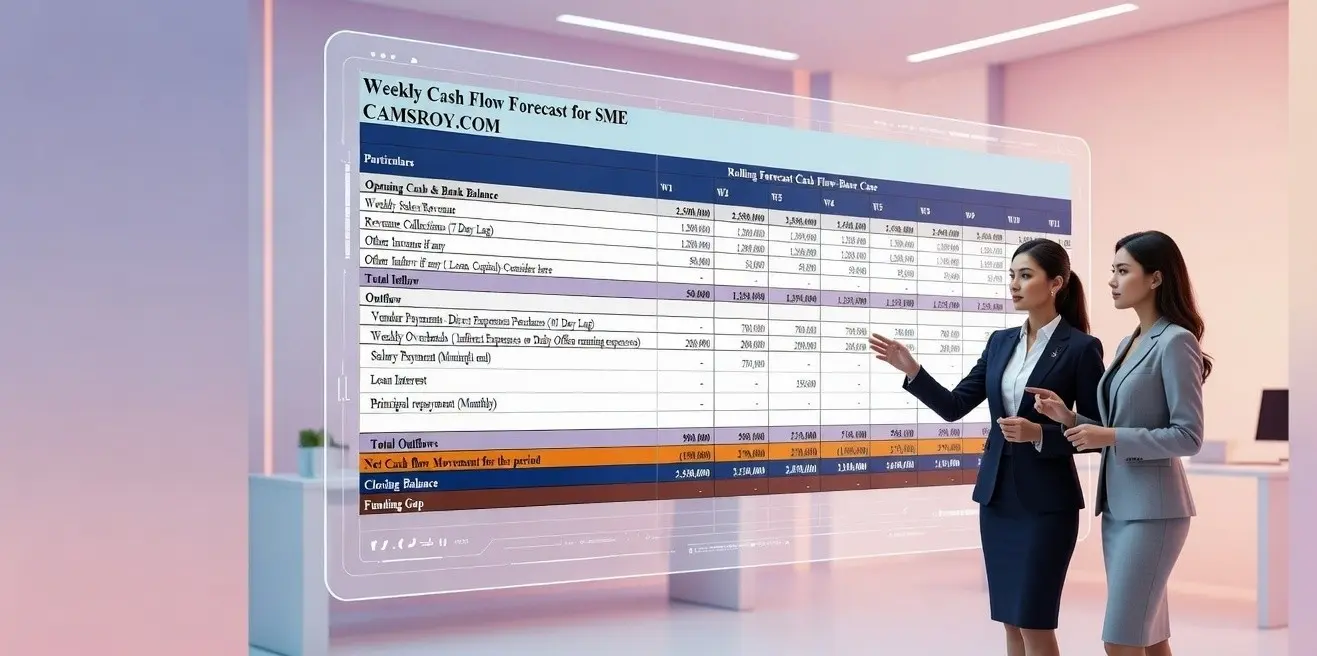
This 13 week rolling cash flow forecast Excel template converts weekly projections into clear liquidity decisions. You enter expected inflows (collections, sales, other receipts) and projected outflows (vendors, salaries, EMIs, taxes, operating costs). The model automatically calculates weekly net movement, closing balances, funding gaps, and cash runway.
Because it operates on a rolling 13-week horizon, each update maintains forward visibility into working capital pressure. Any change in revenue assumptions, payment delays, or expenses instantly reflects in your projected cash position.
This is not just a spreadsheet — it is a structured cash flow projection model in Excel built for practical SME liquidity management. This Cash Flow Model helps you to know:
Tracks opening balance, projected inflows, outflows, and closing cash for each of the 13 weeks. This provides structured short-term cash flow planning and complete visibility over upcoming liquidity movements.

Identifies specific weeks where projected cash may fall below safe levels. This allows timely action such as accelerating collections, deferring payments, or arranging short-term financing before pressure builds.
Calculates how many weeks your current liquidity can sustain operations under existing assumptions. This metric is critical for assessing working capital strength and survival capacity.

Compares normal projections with revenue decline or delayed collection scenarios. This enables proactive liquidity risk assessment and better decision-making under uncertainty.
Liquidity Position KPIs Explained
Effective liquidity management is not about guessing cash availability — it is about measuring risk with clarity. This 13-week rolling cash flow forecast automatically calculates key liquidity risk indicators that help SMEs monitor working capital strength and cash runway in real time.
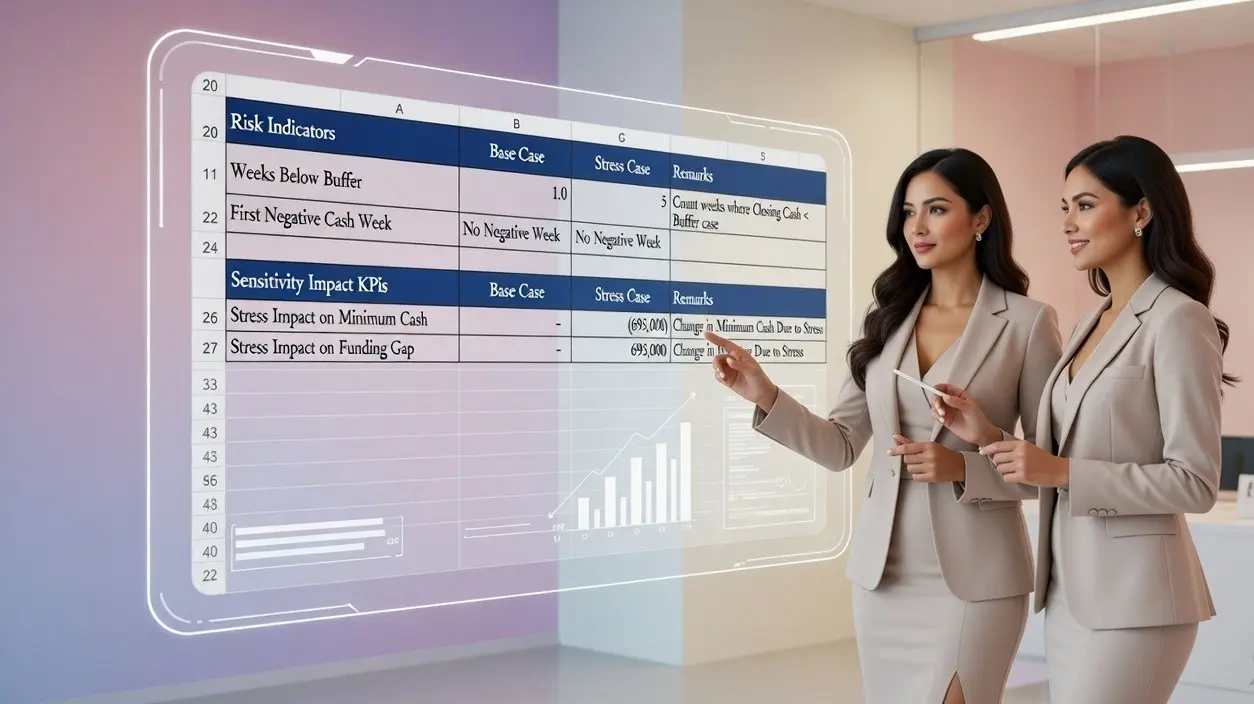
The lowest projected cash balance within the 13-week forecast horizon.
This KPI highlights your worst liquidity point and signals how close the business comes to financial stress. A declining minimum cash position indicates rising liquidity risk.
The highest negative cash shortfall projected during the forecast period.
This metric helps determine the peak working capital requirement and supports discussions with banks for short-term financing or overdraft facilities.
Measures how comfortably projected cash balances cover fixed obligations such as salaries, EMIs, rent, and statutory dues.
A weakening buffer ratio signals increasing liquidity vulnerability and potential operational pressure.
Measures the average net cash outflow during loss weeks only, when projected outflows exceed inflows. This indicates how quickly the business consumes cash during negative operating cycles.
A higher average cash burn increases liquidity risk and shortens cash runway. Monitoring this metric helps SMEs assess sustainability during downturns and supports more accurate cash runway calculation under stress conditions.

Weekly Cash Flow Forecast Dashboard (Base vs Stress Case)
The model includes a visual weekly cash flow forecast dashboard that compares normal projections (base case) with downside scenarios (stress case).
This side-by-side view enables decision-makers to instantly assess liquidity impact under revenue decline, delayed collections, or cost escalation. Instead of reviewing raw numbers, the dashboard presents trends, funding gaps, and cash runway visually — supporting faster, data-driven financial decisions.
Revenue Sensitivity & Stress Testing for SMEs
Liquidity risk often emerges when revenue assumptions fail. This built-in cash flow stress testing model allows SMEs to simulate revenue drops (10–30%), delayed receivables, or sudden expense increases.
By adjusting key drivers, businesses can instantly see the impact on minimum cash position, funding gap, and cash runway — turning uncertainty into measurable risk analysis.
Automated Liquidity Risk Score (0–100) for SMEs
To simplify interpretation, the model generates an automated liquidity risk assessment model score ranging from 0 to 100.
The score is derived from projected cash volatility, funding gaps, buffer strength, and runway duration. A lower score indicates stable liquidity conditions, while a higher score signals elevated risk requiring immediate attention.
This converts complex financial projections into a single decision-ready indicator for business owners and finance managers.
REAL-TIME LIQUIDITY INTELLIGENCE
Automated Financial Insights (Dynamic)
A powerful 13 week rolling cash flow forecast does more than calculate numbers — it interprets them. This model includes an automated financial insight engine that continuously evaluates liquidity risk, funding gaps, buffer strength, and cash runway under both Base and Stress scenarios.
Instead of manually reviewing spreadsheets, you receive structured warnings, quantified funding requirements, and clear risk classifications — converting projections into executive-ready decisions.
This bridges the gap between financial data and proactive liquidity control. These dynamics key assessments transform your cash flow projection model in Excel into a structured liquidity risk assessment system — helping SMEs move from reactive crisis handling to disciplined financial control.
Automatically flags when projected cash falls below the defined safety threshold. Alerts such as “Cash below safe level” indicate elevated liquidity risk requiring immediate attention.

Evaluates whether projected cash comfortably covers fixed obligations such as salaries, EMIs, rent, and statutory dues. “Buffer breached” warnings signal tightening financial flexibility.
Performs real-time cash runway calculation to determine how many weeks the business can sustain operations. “Runway critical (<4 weeks)” highlights survival risk.
Calculates the exact working capital shortfall during negative cash weeks. This supports structured funding planning and lender discussions.
Analyzes volatility in weekly inflows and outflows to assess cash flow consistency under both normal and stress conditions.
Generates an automated score based on funding gaps, volatility, buffer strength, and runway duration — providing a quantified liquidity risk indicator.
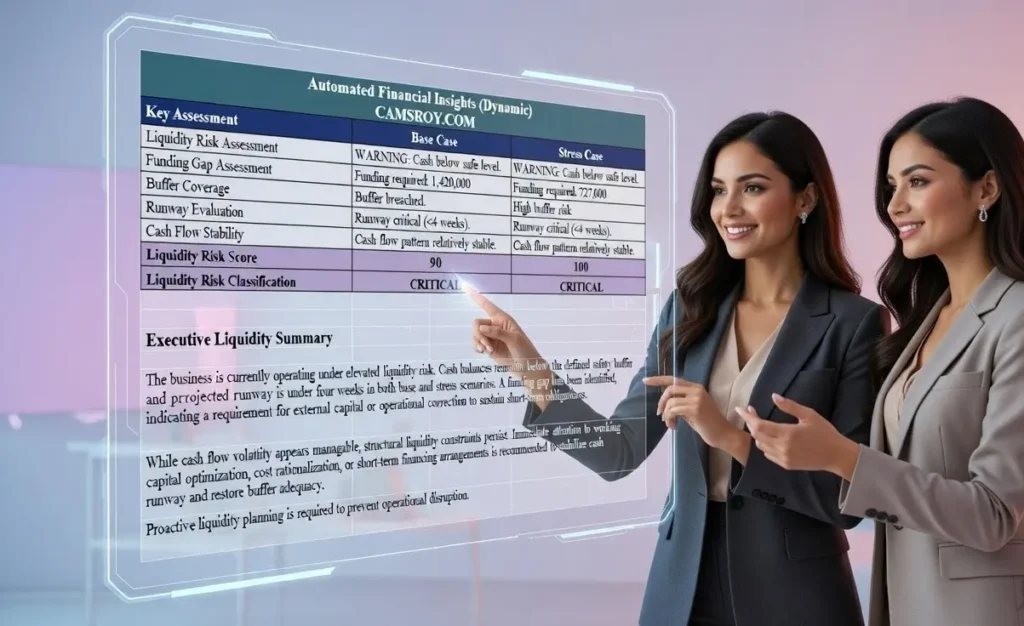
Converts the risk score into clear categories: Low, Moderate, High, or Critical — enabling faster executive decision-making.
How to Use This Cash Flow Projection Model in Excel
This cash flow projection model in Excel is designed for practical weekly implementation, not complex financial modeling. Setup takes only a few minutes, and the model automatically updates calculations once data is entered.
Start by entering your opening cash balance and projected weekly inflows, including customer collections, sales receipts, and other income. Then input planned outflows such as vendor payments, salaries, EMIs, taxes, rent, and operating expenses.
The model instantly calculates: Weekly net cash movement, Closing cash balance, Minimum cash position, Funding gaps, Cash runway (weeks) and Liquidity risk score
Because it follows a 13 week rolling cash flow forecast structure, you simply update actuals at the end of each week and extend the forecast by one additional week — maintaining continuous 90-day visibility.
Simple 4-Step Implementation
Input your current bank and cash balance.
Add expected collections and scheduled payments.
Check funding gaps, cash runway, and liquidity risk indicators.
Replace actual numbers and extend the forecast forward by one week.
IDEAL FOR SME DECISION-MAKERS
Who Should Use This SME Cash Flow Planning Tool?
This SME cash flow planning tool is designed for businesses that need structured short-term liquidity visibility — not just accounting reports.
It is especially valuable for decision-makers responsible for working capital, compliance, and financial stability. This is not just for businesses in crisis.
It is for SMEs that want proactive liquidity control, stronger financial planning, and sustainable growth.
If you manage day-to-day operations and cash commitments, this tool provides weekly clarity on funding gaps, cash runway, and liquidity risk — helping you avoid surprises.
For professionals responsible for working capital control, this 13 week rolling cash flow forecast supports structured reporting, bank discussions, and risk monitoring.
When applying for working capital limits, overdraft facilities, or restructuring discussions, a structured weekly forecast strengthens credibility and demonstrates financial discipline.
Advisors supporting small and medium businesses can use this cash flow projection model in Excel to deliver data-driven liquidity insights and stress testing scenarios.

If your revenue fluctuates, receivables are inconsistent, or expenses are rising, this model helps you anticipate pressure instead of reacting to it.

Download the 13-Week Cash Flow Forecast Excel Template
Cash shortages don’t happen suddenly — they happen when you don’t see them coming.
This 13 week rolling cash flow forecast Excel template for SMEs gives you clear weekly visibility into funding gaps, cash runway, and liquidity risk — so you can take action before problems escalate.
If you want better control over working capital, stronger bank discussions, and confidence in your short-term cash position, this tool gives you a structured, practical solution.
What You Get
- 13-Week Rolling Cash Flow Forecast Structure
- Weekly Cash Position Tracking
- Minimum Cash Position & Maximum Funding Gap
- Cash Runway (Weeks) Calculation
- Revenue Sensitivity & Stress Testing
- Automated Liquidity Risk Score (0–100)
- Base vs Stress Dashboard View
Take control of your liquidity today.
Download the template and strengthen your weekly cash flow planning.
EXPLORE MORE FINANCIAL TOOLS
Explore More SME Financial Planning Templates
If you found this 13-week rolling cash flow forecast helpful, explore additional Excel-based financial planning tools designed for structured business decision-making.
Prefer instant calculations? Use our browser-based financial tools on ToolSuite.




Frequently Asked Questions (FAQ)
Stay Ahead of Liquidity Risk
Managing cash flow is not a one-time activity — it requires ongoing discipline.
Subscribe to receive practical insights on SME cash flow planning, liquidity risk management, working capital optimization, and financial decision frameworks designed for growing businesses.
📩 Get actionable financial tools, updates, and planning templates delivered directly to your inbox.
Enter your email and strengthen your financial control.