
Big 4 Firms Don’t Have Better Judgement Than You. They Just Have a Bigger AI Budget.
I’ve sat close enough to Big 4 audit engagements to see what their AI tooling actually does — and close enough to SME practice to know what a solo or small-team CA firm can realistically build instead. This is an honest, specifics-first comparison, not a sales pitch for either side.
Every few months, a LinkedIn post claims Big 4 firms have some unreachable AI advantage that makes SME practices obsolete. It’s not true, and it’s not useful — it just makes smaller firms feel like they’re already behind before they’ve even started. The real picture, once you actually compare AI in Big 4 audit vs SME CA firms honestly, is more specific and more useful: Big 4 firms have scale-justified tooling for problems that only exist at scale. Most of what actually improves audit and reporting quality — anonymising data properly, treating AI output as a draft, using a consistent verification checklist — costs nothing and works identically whether you have 3 clients or 300.
This article names the actual platforms — Deloitte’s Omnia, KPMG’s Clara, EY.ai, and PwC’s GL.ai — what each genuinely does, and where the comparison to a ChatGPT-based SME workflow holds up and where it doesn’t. I’ve written this from close proximity to both worlds: Big 4-adjacent audit engagements earlier in my career, and hands-on SME practice for the past several years.
If you’ve ever felt a quiet sense of falling behind reading about “AI-powered audit” at the enterprise level, this is meant to correct that feeling with specifics, not reassurance.
📑 Table of Contents
- Deloitte (Omnia), KPMG (Clara), EY (EY.ai/EYQ), and PwC (ChatGPT Enterprise + GL.ai) have each built or bought named, disclosed AI platforms — this isn’t speculation, it’s public record.
- The investment figures are large for a reason: KPMG alone committed $2 billion to a Microsoft partnership targeting $12 billion in incremental revenue, and EY invested $1.4 billion in EY.ai. That scale only makes sense across tens of thousands of professionals.
- What transfers to an SME firm regardless of budget: anonymising client data, using AI for drafts only, and a written verification habit.
- What doesn’t transfer: the orchestration layer, the governance infrastructure, and the multi-year capital commitment — none of which an SME firm needs in the first place.
What each Big 4 firm has actually built
This is where most commentary on “Big 4 AI” stays vague. It shouldn’t, because each firm has been specific in its own public disclosures about its Big 4 audit AI platforms.
Deloitte runs Omnia, its global audit and assurance platform, used by close to 85,000 audit professionals worldwide. In June 2026, Deloitte added a unified “agentic intelligence” layer to Deloitte Omnia — a network of AI agents that can share data and coordinate multi-step workflow tasks, rather than operating as isolated point tools. Separately, Deloitte’s Zora AI, built with Nvidia, automates invoice matching and financial trend analysis internally.
KPMG operates Clara, its global smart-audit platform, built on a $2 billion commitment to Microsoft and Azure OpenAI. KPMG Clara has been projected to deliver over $12 billion in incremental growth from that alliance, and has piloted orchestration agents intended to run routine audit procedures — asset valuations and revenue testing — with reduced manual involvement.
EY built EY.ai, a unifying AI platform spanning strategy, tax, assurance, and risk, backed by a $1.4 billion investment and EY’s own large language model, EYQ. EY has deployed roughly 150 specialised AI agents supporting around 80,000 tax professionals — each agent scoped narrowly to a specific category of tax research or compliance work rather than acting as a general-purpose assistant.
PwC took the broadest workforce-deployment approach, rolling out ChatGPT Enterprise to over 100,000 employees and becoming OpenAI’s largest single enterprise customer. Alongside that, PwC’s GL.ai automates journal entry processing and general ledger anomaly review for audit and internal finance functions. Taken together, these four platforms are the real substance behind any conversation about AI in Big 4 audit vs SME CA firms — not a hypothetical, but four specific, dated, publicly disclosed deployments.
Pro tip
If you’re evaluating whether a specific AI tool is “Big 4-grade,” ask what problem it’s actually solving. If the answer is “coordinating AI agents across 80,000+ professionals,” it’s solving an orchestration-at-scale problem, not a quality problem — and a well-built ChatGPT workflow can likely match the quality on your actual client sizes.
Why the investment gap exists
It’s worth being specific about why billion-dollar platforms exist at all. An enterprise analytics or orchestration platform needs a stable, standardised data pipeline across every client it touches — the same chart-of-accounts structure, the same file formats, the same integration points — because building and maintaining that pipeline is itself a significant engineering undertaking. That cost only gets justified when it’s spread across tens of thousands of engagements run through the same firm, which is exactly the scale KPMG, EY, Deloitte, and PwC are each operating at.
A solo CA or a small partnership simply doesn’t generate enough repeat volume for that infrastructure investment to make sense — and that isn’t a shortcoming on the SME side. It’s a different economic reality, the same way a corner pharmacy doesn’t need a hospital’s supply-chain software to serve its customers well.

AI in Big 4 Audit vs SME CA Firms: Platform-by-Platform Comparison
Here’s the comparison laid out directly — what each named platform does, and the realistic SME-scale equivalent using ChatGPT, Excel, and disciplined process:
| Capability | Big 4 platform | SME-realistic equivalent |
|---|---|---|
| Full-population transaction testing | Deloitte Omnia — agentic AI across the full audit population, ~85,000 professionals | ChatGPT-assisted flux review on exported ledger data, manually verified |
| Audit orchestration across engagements | KPMG Clara — $2B Microsoft/Azure OpenAI partnership, targeting $12B incremental revenue | A written, repeatable ChatGPT checklist — no orchestration layer needed at SME scale |
| Tax research and compliance | EY.ai / EYQ — ~150 specialised agents supporting 80,000 tax professionals | ChatGPT-assisted research per client query, checked against primary statutory sources |
| General ledger and journal entry review | PwC GL.ai — automated anomaly detection at enterprise scale | ChatGPT-assisted variance review on smaller client ledgers, manually verified |
| Invoice and document processing | Deloitte Zora AI (built with Nvidia) — automated invoice matching and trend analysis | ChatGPT-assisted document summarisation, one client at a time |
| Workforce-wide AI access | PwC — ChatGPT Enterprise for 100,000+ employees, OpenAI’s largest enterprise customer | A single ChatGPT Plus or Team subscription per practitioner |
| Cost of entry | Multi-billion-dollar, multi-year capital commitments | Near-zero to a few thousand rupees a month |

What’s genuinely copyable at SME scale
Three things transfer directly, regardless of firm size, and cost nothing to start doing tomorrow.
Anonymising client data before it reaches any AI tool. This isn’t a Big 4 luxury — it’s a baseline every firm should have, and it’s exactly as achievable with a simple find-and-replace habit as it is with an enterprise data pipeline.
Treating AI output as a draft, never a finding. Every Big 4 platform described above — Omnia, KPMG Clara, EY.ai, and, PwC GL.ai — is publicly positioned as augmenting professional judgement, flagging exceptions for human review rather than signing off independently. That exact principle — AI drafts, a human verifies — is the same rule an SME firm should apply to a ChatGPT-drafted variance note.
A written policy, however short. You don’t need a governance committee. A one-page document stating what data can and can’t go into AI tools, and who’s responsible for reviewing AI-assisted output, gets you most of the actual risk protection a large firm’s formal AI governance provides.
What isn’t copyable, and why that’s fine
Enterprise platforms like Clara or Omnia exist because checking every transaction across tens of thousands of parallel engagements needs infrastructure no SME firm will ever require — you don’t have KPMG’s engagement volume, and you don’t need to. Dedicated AI governance and orchestration layers exist because coordinating consistent AI use across 80,000+ professionals needs structure that a 3-person firm simply doesn’t need, since one founder can enforce a policy directly. None of this is a gap to feel behind on — it’s tooling built for a problem you don’t have.
CHECK
REQ’D
What still needs manual judgement, at any firm size
Whether you’re using a multi-billion-dollar analytics platform or a ChatGPT prompt, the exceptions it flags still need a human to trace back to source documents and confirm they’re genuine. Scale changes the tooling. It doesn’t change this step.
The honest bottom line
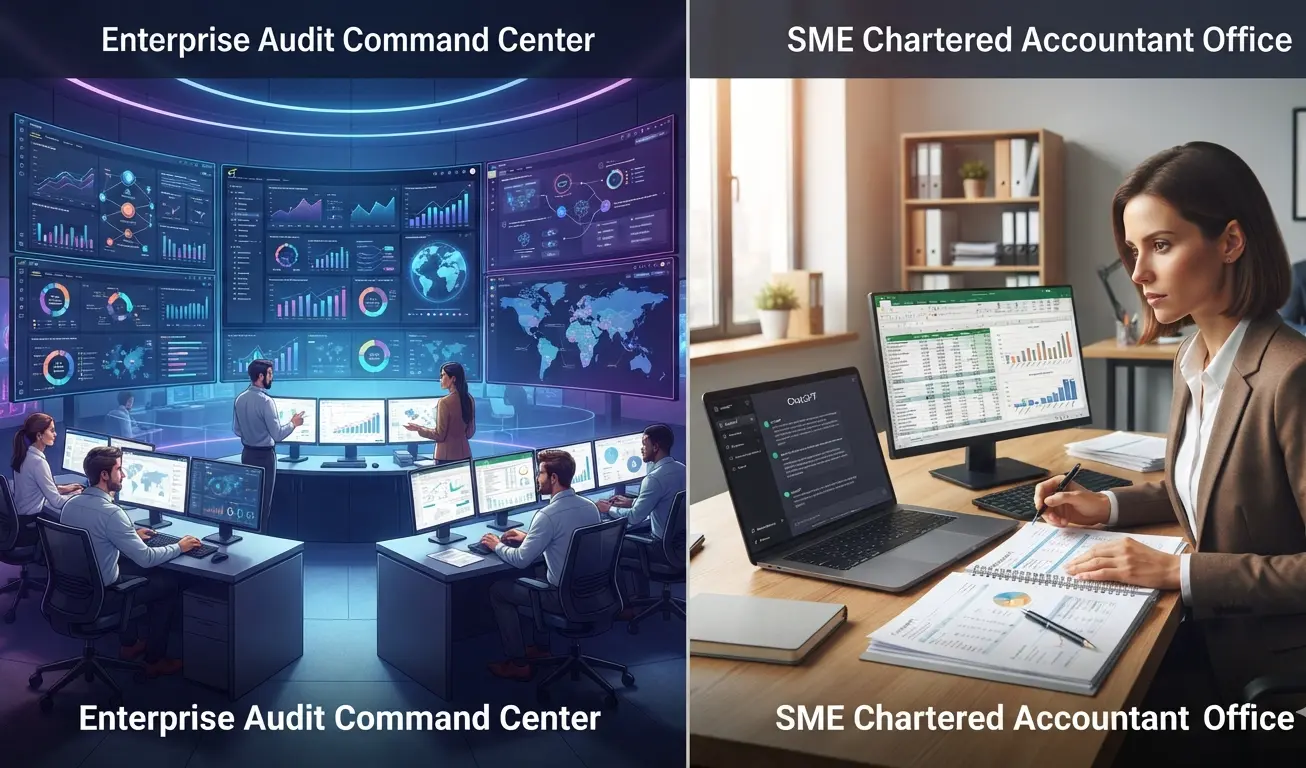
Weighing AI in Big 4 audit vs SME CA firms fairly means accepting two things at once: the enterprise tooling is genuinely more capable at enterprise scale, and that fact is almost entirely irrelevant to how you should run your own practice. Your competitive edge as an SME CA was never going to come from matching KPMG’s $2 billion Microsoft partnership or EY’s 150-agent tax platform. It comes from the same thing it always has — knowing your clients’ businesses closely enough that judgement, not throughput, is what they’re actually paying for. AI, used well at your scale, frees up more time for exactly that.
Big 4 vs SME AI: Questions I Get Asked
What AI platforms do the Big 4 firms actually use?
Can an SME CA firm actually afford Big 4-style audit AI tools?
Is Big 4-style AI actually better than what an SME CA can build with ChatGPT?
What can a small CA firm realistically copy from Big 4 AI adoption?
Do Big 4 firms verify AI output manually, or do they trust it fully?