
If you are trying to pick an AI model this year, here’s the hard truth: the “best” one depends on what you need done—not who shouted the biggest launch. GPT-5, Claude Opus 4.1, and Grok 4 are all excellent, but they shine in different situations.
In this explainer, I tried to break down what’s new in GPT-5, where Claude and Grok win, and how to choose the right model for everyday work—finance and non-finance—without wasting money or time.
Quick take of each AI model
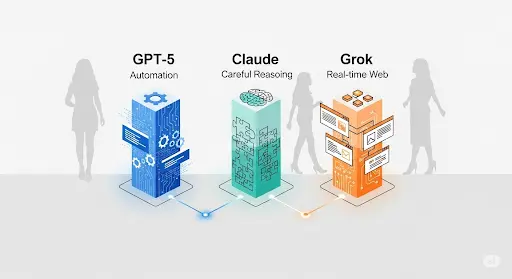
- GPT-5: it is a powerful all-rounder with stronger reasoning, better coding/automation, larger context windows, and tighter “agent” workflows. Great when you want one model to research, analyze, and automate tasks end-to-end.
- Claude Opus 4.1: It is meticulous, careful, and excellent at long-form reasoning. It’s the model you pick when the output must be clear, structured, and defensible (policies, memos, audits, sensitive analysis).
- Grok 4: It is built for live, real-time awareness and quick answers from the open web plus tools. Perfect when your question depends on “what changed today?”
What’s new in GPT-5 (and why it actually matters)
1) Deeper reasoning for messy, multi-step work
GPT-5 handles longer chains of thought with fewer stumbles. In practice, that means you can ask for a process, not just an answer. For example:
- “Pull last quarter’s sales and expenses, find anomalies, draft a variance note for management, and suggest three actions.”
- “Take these three GST circulars, summarize changes, map them to our process, and write a client email in plain English.”
You will notice fewer restarts and less hand-holding.
2) Larger context windows (goodbye, constant ‘continue’ prompts)
GPT-5 can comfortably hold big conversations and reference packs—think policy PDFs, meeting notes, CSV extracts, and emails in one place. The result is coherence: it remembers what you said 15 minutes ago and threads it through the current answer.
3) Better at coding and “agentic” flows
GPT-5 writes cleaner scripts, debugs faster, and is easier to point at real tasks:
- Finance ops: reconcile bank lines, flag outliers, export a formatted Excel, and draft the CFO summary.
- Marketing ops: pull top-performing posts, rewrite captions, schedule a calendar draft.
- Customer ops: triage support emails, suggest replies, and raise tickets with tags.
It is not just generating text but also designing mini-workflows.
4) Tiers for cost control
Many teams’ route simple extraction to lighter GPT-5 variants and keep the full model for heavy reasoning since, you don’t need a sports car to deliver groceries. Smart routing keeps your bill sane.
5) Multimodal is more natural
Reading screenshots, parsing charts, and understanding layouts has improved. You can drop a dashboard image, ask “What changed month-over-month?” and get something usable. For non-finance, it’s great for product screenshots, UI feedback, and study notes from slide decks.
Where Claude Opus 4.1 is still a star
Claude’s personality is as a “thoughtful analyst.” It tends to write like a careful professional who shows their work and avoids leaps.
- Long-form accuracy: policies, audit narratives, training manuals, SOPs, proposals, and research memos.
- Careful reasoning: when you want deliberate step-by-step logic, edge-case checks, and crisp structure.
- Explain-as-you-go code: Claude will tell you why a function is written a certain way, which helps teams maintain scripts.
If you are drafting anything that a regulator, auditor, or board might read, Claude Opus 4.1 is a safe bet.
Where Grok 4 changes the game
Grok 4 leans into real-time context. It’s quick, opinionated, and strong at weaving news, public data, and web sources into a response.
- Compliance & news monitoring: “Summarize the latest updates affecting GST input credit, with links.”
- Market & trend scouting: “What’s moving SMB lending this week? Summarize five credible sources.”
- Competitive intelligence: “Compare pricing pages of X and Y; highlight the deltas.”
If your question depends on what happened today, start with Grok 4 and then polish or automate with GPT-5/Claude.
Next Question is which model for which task?
If you need…
- A careful, defensible memo/policy → Claude Opus 4.1
- A working automation, script, or end-to-end task → GPT-5
- Live information from the web, right now → Grok 4
- Long document digestion → Claude or GPT-5 (Claude for caution; GPT-5 for speed + follow-on automation)
- Brainstorming, drafts, and variations → GPT-5 (fast iteration), Claude (polished drafts)
- Rapid situational briefings → Grok 4
No model is “the universally best”; you need to likely use combination of two: GPT-5 as default plus Claude for sensitive writing (and Grok when the web matters).
Finance, accounting, tax: practical use cases (that save your real hours)
- Month-end close helper (GPT-5)
Use it to reconcile high-variance accounts, and draft a variance note. Then ask it to create a clean table for your management deck. - GST/Income-tax change notes (Grok 4 → Claude)
Use Grok 4 to gather fresh circulars and trusted commentary, then hand it to Claude to draft a client-friendly explainer with caveats and examples. - Audit workpaper summarizer (Claude)
Feed testing results and exceptions; ask for a concise narrative with control objective, test steps, exceptions, and management response. - FP&A forecasting stencil (GPT-5)
Share CSVs, define drivers, and ask GPT-5 to build a quick sensitivity write-up—then generate a short “Executive View” paragraph for leadership. - Expense & invoice automation (GPT-5 tiers)
Route extraction to a lighter tier, route anomaly reasoning to the full model. Keep unit costs low without sacrificing quality. - Policy & SOP drafting (Claude)
Create a “house style” and ask Claude to enforce it. It will keep tone consistent across finance, procurement, and IT policies. - Compliance watch (Grok 4)
Set up a daily brief: “Summarize credible updates on your domain with links and a one-line impact note.”
Non-finance use cases
- Marketing: generate messaging angles, turn webinars into blog posts, create UTM-ready ad variations, and suggest hooks for short videos.
- Sales: tailor outreach emails by persona; generate talk tracks and objection handling crib notes.
- HR & L&D: write role scorecards, create onboarding checklists, and turn SOPs into simple “micro-lessons.”
- Product: summarize user interviews, organize feature requests, and create developer stories.
- Customer support: draft tone-consistent replies and knowledge-base articles; auto-tag issues.
- Education: build study notes from textbooks, create quizzes, and turn lecture slides into revision cards.
- Software engineering: bootstrap internal tools, write tests, convert legacy snippets, and summarize PRs.
- Creative: storyboard shorts, write captions, and brainstorm podcast episode outlines.
A simple model-selection flow (use this every time to choose the right AI)
- Does the answer depend on today’s information?
- Yes → Start with Grok 4 to collect sources.
- No → Go to step 2.
- Is the output a sensitive document or requires clear reasoning?
- Yes → Claude Opus 4.1 for the draft.
- No → GPT-5 for speed and automation.
- Do you also need an automation or app?
- Yes → Build with GPT-5; route data-extraction steps to a lighter tier.
- No → Stay with the drafting model you picked.
- Quality check
- Ask the other model to review the draft (“red-team” it). This catches blind spots.

Prompts & mini-workflows you can copy
Finance variance note (GPT-5)
“You’re my FP&A copilot. I’ve uploaded two CSVs: P&L by cost center (current vs prior) and a mapping file.
- Identify top 8 variances by absolute value and % change.
- Attribute likely drivers using the mapping file.
- Draft a 200-word variance note in plain English with 3 recommended actions.”
GST update explainer (Grok → Claude)
Grok: “Find today’s credible updates impacting GST input tax credit. Return links + one-line summary per source.”
Claude: “Using those links, draft a 500-word explainer for SMB owners; include a 4-point ‘What to do now’ checklist.”
Policy writing (Claude)
“Write a 1,200-word Accounts Payable policy in our house style: short sentences, active voice, numbered steps, and a 7-point control checklist.”
Marketing repurpose (GPT-5)
“Turn this webinar transcript into: 1 blog draft (~1,200 words), 3 LinkedIn posts, and 6 YouTube Shorts hooks.”
Implementation checklist (keeps you compliant and efficient)
- Data hygiene: mask PII and bank details before uploading.
- Ground your answers: store your policies/FAQs and let the model retrieve snippets (RAG) rather than “guess.”
- Guardrails for agents: add approvals and logs for anything that sends emails, touches data, or posts entries.
- Version prompts: save “golden prompts” for recurring tasks and keep a tiny changelog.
- Cost control: tag workloads by model/tier and review weekly.
- Quality loop: spot-check outputs and keep a library of “good answers” to fine-tune prompts over time.
Download here– AI MODEL SELECTION FLOWCHART + PROMPT PACK
FAQs
Which model is best for finance teams?
Use GPT-5 for day-to-day automation and analysis, Claude Opus 4.1 for careful, policy-grade writing, and Grok 4 when your question depends on fresh web info.
I’m a small business—can I just use one model?
Yes. Start with GPT-5. Add Claude when you begin publishing policies or long-form content, and use Grok for news-sensitive checks.
Which is best for coding small internal tools?
GPT-5. It’s strong at stitching prompts into mini-apps and scripts. Ask for explanations if you’re new to code.
What about students or non-finance users?
Students and creators can use GPT-5 for learning, brainstorming, and drafts; Claude for clean essays and study guides; Grok for current affairs summaries.
Is my data safe?
Use enterprise settings where available, avoid uploading sensitive personal data, and store reference documents in your own secure drive that the model reads from—not the public web.
Can I combine models in one workflow?
Absolutely. A popular pattern: Grok (collect links) → Claude (structured draft) → GPT-5 (automate outputs, build dashboards).
Conclusion: Your smartest 2025 stack
- Default: GPT-5 for research, analysis, and building small automations.
- Precision: Claude Opus 4.1 when the output must be careful, structured, and defensible.
- Fresh context: Grok 4 for anything that changes daily.
Use two models day-to-day; bring the third when you need it. That’s the sweet spot for speed, quality, and cost.
Disclaimer
Content on CamsRoy.com is for general information only and isn’t financial, tax, legal, or professional advice. Please verify details and consult a qualified professional for your situation.
This post may contain affiliate links—we may earn a commission at no extra cost to you (as an Amazon Associate, we earn from qualifying purchases). Prices, features, and availability can change; external sites are outside our control.