

AI Agents—Cut DSO & Errors, Stay Compliant
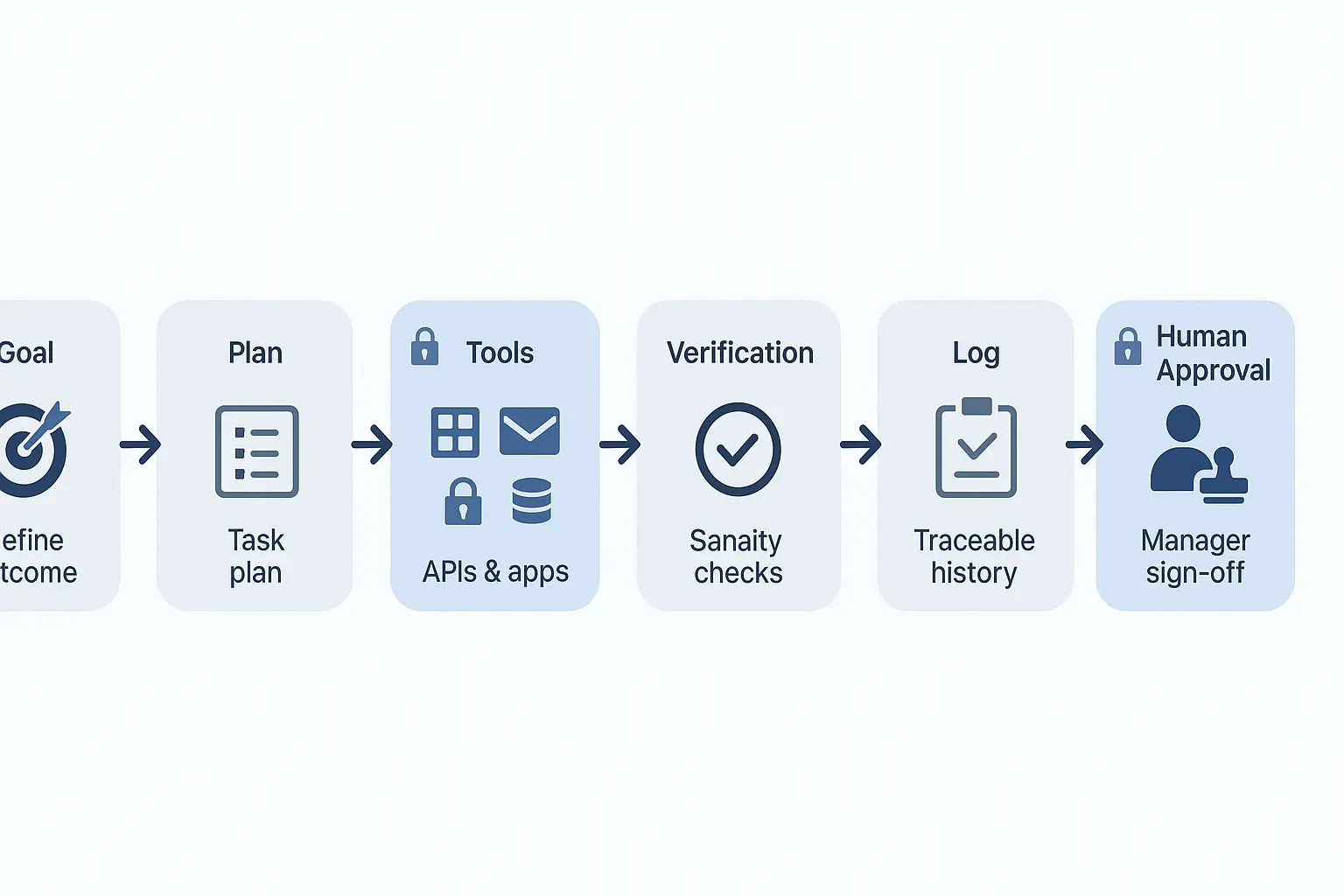
If AI in the last few years felt like fancy chat, 2025 is the year it starts doing your work. An AI agent is not a chatbot that only answers; it is a software teammate that understands a goal, breaks it into steps, uses your tools and data to act, checks the results, and leaves a short log of what happened. In India, this lands at the right time. People are comfortable paying by UPI links, signing digital forms, and chatting on WhatsApp for business. Based on facts, it’s clear that national programs like the IndiaAI Mission are expanding compute and skills, while the Digital Personal Data Protection (DPDP) Act makes privacy a real product requirement rather than a policy on paper. As per my experience, the teams that win do three simple things: pick one narrow use case, keep human approvals for money and statutory filings, and measure a visible outcome each week—such as hours saved, errors avoided, or Days Sales Outstanding (DSO) reduced. In my view, once one small win is visible, adoption follows naturally.
This guide explains AI agents in simple language—what they are, where they help, and how to deploy them safely. You’ll see practical use cases across finance, audit, HR, and support; a simple ROI formula with a worked example; and the minimum controls to keep management, auditors, and customers comfortable. Start with one small workflow, keep approvals for anything risky, measure weekly, and expand only after the first clear win.
What an AI agent really is
An AI agent is a software teammate—a program that takes a goal, plans the steps, uses only your approved tools (via APIs/apps), checks its work, keeps a log, and asks for human approval for any risky action. Think of the colleague who quietly prepares half your work before the meeting. That is what an AI agent aims to be. You tell it the outcome—“prepare a GST mismatch pack,” or “remind customers with pending invoices”—and it plans the steps, fetches the right files or data, calls the tools it is allowed to use, and then shows you the result. You remain in charge. You approve payments, filings, and anything that goes outside the company. The biggest shift is that repetitive glue‑work moves from your plate to the agent, and you get time back for judgment, review, and client conversations.
Example: Suppose a young accounts executive in Jaipur sets an ai agent to check the purchase register against GSTR‑2B every Friday. The agent highlights mismatches, drafts polite emails for vendors, and saves an evidence folder. She reads the drafts, makes small edits, and sends. What earlier took half a day becomes a short review. Over a month, the team starts trusting the pattern because the audit trail is clean.
Points to remember:
- Keep the goal simple. Let the agent do one thing end‑to‑end.
- Give access only to the tools and folders it truly needs.
- Add a human approval step for anything risky or external.
Why 2025 suits India
India has the digital habits, the infrastructure, and the rules—all at once. UPI volumes show that people accept automated payment prompts and quick links. The IndiaAI Mission is adding shared compute and training so pilots become cheaper. The DPDP Act, 2023, which is now in force, asks you to limit purpose, show clear notices, minimise data, secure it properly, and delete it on time. And in securities markets, SEBI’s 2025 consultation sets a direction for responsible AI agent/ML use—transparency, auditability, fairness, and governance. Together, these are not hurdles; they are the rails that make ai agent projects repeatable and safe.
Points to remember:
- Write privacy and approvals into the design, not as an afterthought.
- Prefer platforms that keep a log of actions (who did what, when, using which data).
- Pilot where data quality is good; expand only after results hold for 3–4 weeks.
How ai agents actually work day‑to‑day
The working day of an ai agent is quite boring—in a good way. It reads a schedule or a trigger, opens a dataset or export, plans a few steps, runs them, checks for simple mistakes, saves a log, and nudges you when it needs approval. If the path changes—say a file format is slightly different—it tries an alternative and tells you what changed. The magic is not the chat; the magic is the steady rhythm of small, correct steps with a clean record.
In practice, this means agents call your familiar tools: spreadsheets, mail, calendars, WhatsApp Business, CRM, Tally or Zoho, cloud drives, and the GST portal exports. The fewer systems you involve at the start, the smoother it feels. Think of it as you would a new intern: fewer responsibilities on day one, more only after they perform well.
Finance & accounting: where cash and confidence improve
Finance work in India is full of structured steps, repeating every week and every month. That is why ai agents are a natural fit. Start with the flows that touch cash or audit evidence. Two patterns get results quickly. First, a collections agent that reads your aging report and sends polite reminders with a UPI link or payment gateway link, tracks who opened, who clicked, and who paid, and raises a flag for disputes. Second, the GST mismatch pack we described earlier. When you run these two for even one quarter, patterns appear—fewer follow‑ups, faster cash, and a tidy folder for the auditor.
Example: Suppose a trading firm in Surat has implemented the Ai agent and the finance team scheduled its collection agent to run reports twice weekly; each run sent reminders with the invoice PDF and a one-tap UPI link. After eight weeks, DSO fell by about seven days. The improvement was not magic; it was simply that customers found it easy to pay right away. The team kept approvals for write‑offs and disputes with humans, so quality stayed high.
Points to remember:
- Decide what ‘evidence’ means before you start; save it the same way every time.
- Respect tone in reminders; polite, short messages work best.
- Review numbers every Friday and tune the cadence based on response.
Compliance & audit
Auditors do not expect perfection; they expect clarity. Agents help by creating clean trails without nagging your team all month. A simple PBC (Provided‑by‑Client) tracker ai agent can send requests with due dates, store uploads in the right folders, and show a status dashboard. A sampling agent can pull the population from your ledger, apply your policy, and produce a list with reasons and a seed so you can reproduce the sample. A working‑papers ai agent can stitch evidence, policy extracts, and reviewer notes into a single PDF with bookmarks.
If you are a CA, this is where your judgment shines. Keep approvals for conclusions and management letters with partners. Let the AI agent reduces the chasing, assembling, and indexing. In my view, this is how you increase quality without burning weekends.
Points to remember:
- Apply least‑privilege access to client folders, and log every material action.
- Save the random seed and method for any sample; it saves hours later.
- Lock final working papers and keep a version note with who approved and when.
HR & admin: onboarding that feels coordinated
Onboarding is a checklist that touches many teams. An AI agent can generate the offer letter, collect KYC with a clear DPDP notice, create IT tickets for accounts and assets, book the induction slot, and share a 30‑60‑90 plan with the manager. None of this removes the human welcome; it simply removes the confusion. One place to track, one folder for documents, and a short log for compliance.
Points to remember:
- Show notices at the exact moment of data capture; save consent references.
- Collect only what is needed; mask or remove sensitive fields you will not use.
- Define how long you keep onboarding data and who can see it.
Sales & support: faster answers, faster orders
Customers write on WhatsApp because they expect speed. An agent can answer common questions, check stock and price, create a small quote, and send a secure payment link. After payment, it emails a GST invoice, updates inventory, and closes the ticket. For returns, the same agent can collect a reason and photos, validate against policy, create a pickup, and update the ledger. The experience feels tidy because each step gets done in order without back‑and‑forth.
Points to remember:
- Use approved templates in the language your customer picked; be concise.
- Route edge cases to a human chat quickly; do not pretend the agent knows everything.
- Measure the value as cash collected or cases closed, not just messages sent.
Students & early‑career: structure wins over speed
Use an AI agent as a study coach. It can convert your class notes into flashcards, schedule revision blocks on your calendar, and set a quick quiz before each exam. The learning still comes from you. The agent keeps you honest about time and helps you focus on weak areas. For early‑career professionals, a small career agent can tailor your resume to Indian job posts, schedule follow‑ups, and remind you of interview prep without being pushy.
Points to remember:
- Ask the AI agent to structure work; keep reasoning and final answers yours.
- Keep your data private; review outputs before you share or submit.
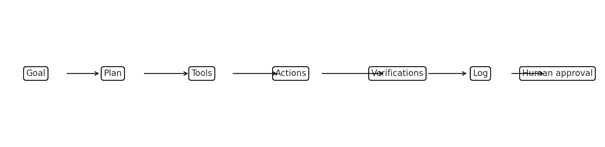
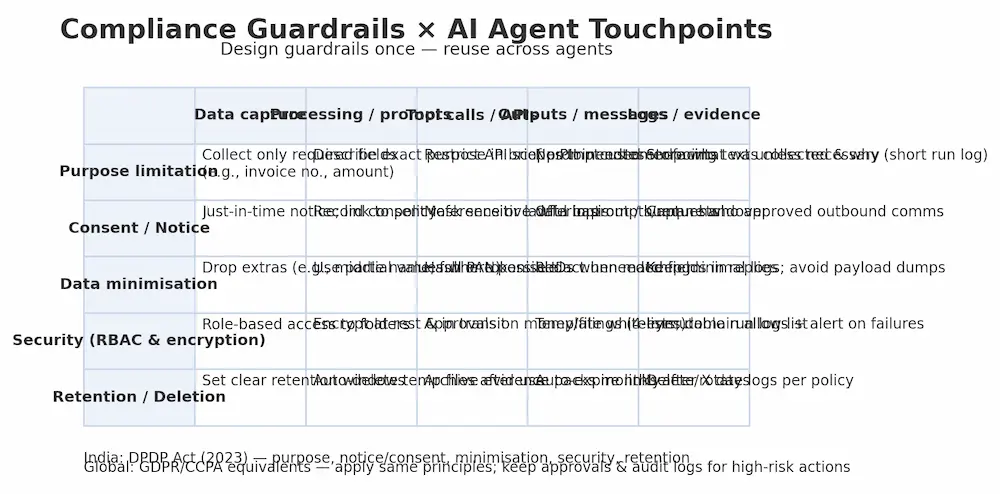
AI Agent Flow & Compliance Map (at a glance)
Agent lifecycle flow:
Compliance canvas mapping DPDP principles to agent touchpoints:
GST ITC Reconciliation ai Agent (Example)
You can implement ai agent with Microsoft 365/Copilot Studio, Google Workspace + Apps Script, or a custom stack. Replace tool names with what you already use (Tally/Zoho, Razorpay/PayU, WhatsApp Business API, etc.). Keep approvals for money, filings, and any external communication. Please follow the below step for implementation.
**Purpose:** Reduce ITC leakage and prepare evidence‑ready mismatch packs every week.
**Who uses it:** Accounts executive → reviewed by Senior Accountant/CA.
**When it runs:** Every Friday 11:00 AM; re‑run on month‑end.
**Inputs (exact):
- GSTR‑2B JSON/CSV export from GSTN
- Purchase register (CSV/XLSX) with columns: Supplier GSTIN, Invoice No/Date, Taxable, IGST/CGST/SGST, Total
- Vendor master with emails/WhatsApp numbers (CSV)
**Steps (do this):
- 1) Load GSTR‑2B and purchase register into a sheet/DB; normalise date & invoice formats.
- 2) Match on GSTIN + Invoice No + amount tolerance (±₹1 rounding); flag Missing/Partial/AmountDiff.
- 3) Auto‑prepare a **Mismatch Sheet** with filters and comments.
- 4) Draft vendor emails/WhatsApp messages for each mismatch category.
- 5) Save an **Evidence Pack**: inputs, mismatch sheet, draft communications, and a run log.
- **Human approvals:** Senior reviews the mismatch sheet and messages before sending.
- **Outputs:** `/GST/ITC/YYYY‑MM/` folder with 01_inputs, 02_mismatch, 03_vendor_drafts, 04_log.txt
- **KPIs:** weekly mismatch count; resolved within 10 business days; net ITC claimed vs eligible.
Build vs buy vs hybrid: pick speed, control, or both
Buying gives speed. Building gives control. Most teams in India choose a hybrid approach: they buy for common “knowledge work” tasks (mail, docs, approvals) and build one or two signature agents for flows that are unique—like GST reconciliation with your local ERP. The test is simple: can you log actions, export evidence, control access by role, and change the flow without waiting on a vendor? If the answer is yes, you will be fine either way.
ROI you can defend in a meeting
ROI from ai agents is visible when you count three things together: time saved, cash accelerated, and errors reduced. The formula is simple enough to use in your first month. Benefit equals hours saved multiplied by the fully‑loaded hourly cost and the number of weeks, plus cash accelerated multiplied by the cost of capital for roughly ninety days, plus the cost of rework you avoided. Cost equals tools, compute, integration, and the time spent on governance and training. ROI is the difference divided by the cost. The maths is not the point; the habit is. Measure weekly, tune the process, and redeploy saved hours to reviews and client time.
FormulaBenefit/month = (Hours saved × Hourly cost) + (Errors avoided × Cost per error) + (AR × Cost of capital × DSO days/365)ROI = (Benefit − Monthly costs − One-time/12) ÷ (Monthly costs + One-time/12)
Example
- Hours saved: 14 hrs/month; hourly cost ₹800 → ₹11,200
- Errors avoided: 5/month; ₹1,200 each → ₹6,000
- (Optional) AR ₹1,00,00,000; cost of capital 12%; DSO −5 days → ₹16,438
- Tool cost ₹6,000/month; one-time setup ₹36,000 (~₹3,000/month)
Net benefit/month = 11,200 + 6,000 + 16,438 − (6,000 + 3,000) = ₹24,638
Points to remember:
- Pick one metric that matters and publish it each Friday.
- Count governance and training as real costs; they make adoption stick.
- Redeploy saved hours; do not let them vanish into unplanned work.
Risk and compliance: DPDP and SEBI in practical terms
Compliance is not a brake; it is a seatbelt. The DPDP Act expects you to limit the purpose for which you collect data, show a clear notice at the time of collection, minimise the data you use, secure it, and delete it on a schedule. You also carry duties if there is a breach. If you operate in or around securities markets, SEBI’s June 2025 consultation sets principles for how AI agent/ML should be used—make it transparent, auditable, fair, and governed. None of this blocks you. It simply pushes you to build agents that leave evidence and respect approvals.
Points to remember:
- Maintain a short data register: systems → purposes → retention → owners.
- Log who approved what and when; export logs to a safe folder each month.
- Keep a simple kill‑switch: if outputs look wrong, stop and review.
A 30‑60‑90 day plan you can copy
Days 0–30: pick one use case; map data sources and approvals; write a one‑page brief; draft DPDP notices; and define success in one line (for example, “reduce DSO by five days”). Days 31–60: build a basic flow, switch on logging, run it with three to five users, and review exceptions each week. Days 61–90: train more users, add a small dashboard for SLAs and exceptions, publish a two‑page SOP with screenshots, and only then move to a second use case.
Conclusion: small wins, steady habits, real value
AI agents are not here to replace people. They are here to remove the messy glue‑work and give you time back for decisions, reviews, and client work. India—because of UPI behaviour, affordable compute, and clear guardrails—is ready. Start narrow, keep approvals for risk, and count results every week. In my view, that rhythm is what turns a demo into a dependable habit. Based on facts, it’s clear that teams who combine process clarity, clean data, and simple governance not only work faster—they work with more confidence and fewer surprises.
FAQ-AI Agent
What is an AI agent in simple words?
A software teammate. You give it a goal; it plans steps, uses tools, finishes the task, and shows a log. You approve risky actions like payments or filings.
How is an agent different from a chatbot or RPA?
Chatbots answer. RPA repeats clicks. Agents plan, act, and verify using your data and tools, and adapt if the path changes
Is using agents legal under India’s DPDP Act?
Yes—if you follow purpose limitation, clear notice, data minimisation, strong security, and timely deletion. Keep human approvals for sensitive actions.
What is a good first use case for SMEs?
Collections with UPI links or GST mismatch packs. Both show quick gains: faster cash and cleaner evidence for audits.
Will agents replace CA jobs?
No. Routine steps shrink, but judgment, ethics, and client advisory grow. Agents help you document work better and faster.
What ROI can I expect in 60–90 days
Time saved, cash accelerated, and fewer errors. Track all three, subtract tool and training costs, and publish the number weekly.
Can ai agents work in Indian languages?
Yes. Use approved templates on WhatsApp and test clarity before scale. Keep tone polite and simple.
How do I prevent hallucinations?
Ground tasks in structured data, keep the scope narrow, add approvals, and review logs weekly for odd outputs.
What about data security?
Use role‑based access, encrypt data at rest and in transit, and rotate access keys. Export logs to a safe folder each month.
How should students use ai agents?
For structure—notes to flashcards, a revision calendar, and pre‑exam quizzes. Do not outsource thinking; use it to manage time.
Can freelancers benefit from ai agents?
Yes—an inbox agent can triage leads, draft quotes, and book calls. Measure success as invoices paid, not emails sent.
What if I use Tally or Zoho?
Start with exports and simple connectors. Keep the first flow inside the tools your team already knows.
How do I avoid vendor lock‑in?
Choose platforms with exportable logs and modular connectors. Keep your data in neutral formats like CSV and PDF
When should I scale to more ai agents?
After one use case runs smoothly for two to four weeks with clear gains. Let other teams request it—organic pull is a good sign.
Do I need a big budget to start?
No. Start with one small flow, existing tools, and clear approvals. Upgrade only when the first result is proven.
Disclaimer
This article is for education and general information only. Always review outputs and apply professional judgment. Follow the Digital Personal Data Protection Act, 2023, and, where relevant, SEBI’s consultation on responsible AI/ML usage in Indian securities markets.
Related Reading
Sources & References
Press Information Bureau — IndiaAI Mission (2024 approval; 2025 update): https://www.pib.gov.in/PressReleaseIframePage.aspx?PRID=2012357 , https://www.pib.gov.in/PressReleasePage.aspx?PRID=2108810
MeitY / Gazette — Digital Personal Data Protection Act, 2023: https://www.meity.gov.in/static/uploads/2024/06/2bf1f0e9f04e6fb4f8fef35e82c42aa5.pdf , https://egazette.gov.in/WriteReadData/2023/247847.pdf
SEBI — Consultation paper on responsible AI/ML usage (20 June 2025): https://www.sebi.gov.in/reports-and-statistics/reports/jun-2025/consultation-paper-on-guidelines-for-responsible-usage-of-ai-ml-in-indian-securities-markets_94687.html
Microsoft Learn — Copilot Studio security & governance (Purview logs, RBAC): https://learn.microsoft.com/en-us/microsoft-copilot-studio/security-and-governance
Microsoft Learn — Audit Copilot Studio activities in Microsoft Purview: https://learn.microsoft.com/en-us/microsoft-copilot-studio/admin-logging-copilot-studio
ICAI — AI Innovation Summit (AIS 2025) & AICA certificate: https://ai.icai.org/ais2025/ , https://ai.icai.org/aica.php